




Nice cars other than x-fire

By the mid 1930s, the Great Depression was mercilessly wiping out America’s grandest luxury car brands. Pierce Arrow, Duesenberg, and Marmon were vanishing, and Lincoln was sliding toward the exact same fate. Its custom Model K cost as much as a suburban house, leaving dealerships practically empty.

Edsel Ford knew the company needed a completely fresh playbook. Working with designer Bob Gregorie, he introduced the aerodynamic Lincoln Zephyr. Unlike the awkward Chrysler Airflow, the Zephyr captured stunning Art Deco elegance with its raked prow, flush headlamps, and tapered teardrop tail. Under the hood sat an exclusive flathead twelve cylinder engine, yet the car was priced affordably at $1,300.

By 1939, the three window coupe gained hydraulic brakes and that iconic central instrument tower. Zephyrs quickly represented over 80% of Lincoln production, keeping the company alive while legendary rivals quietly died.


1789517945760.webp
 
Max Verstappen vs 100 go carts. He starts at the back of the field. This is another example of why he is arguably the best driver to ever climb into a race car of any type.
 
Max Verstappen vs 100 go carts. He starts at the back of the field. This is another example of why he is arguably the best driver to ever climb into a race car of any type.
No way he could start that much faster than others in a straight line unless he has a faster kart.
 
No way he could start that much faster than others in a straight line unless he has a faster kart.
Did seem a bit quicker at the start but he did avoid running into anyone unlike a lot of them . But if you go to the 2 minute mark when he is chasing the front 3 they seem to have the same pase and every pass he makes from that point on is from taking a better line . At any rate to weave past 63 of them in the first lap is pretty crazy considering the traffic. Slightly quicker cart or not. Hard to say for sure. Found this of course......

The 100 challengers did not receive carts randomly. They all used identical karts, and their starting positions were determined by a single flying-lap qualifying session:
Each of the 100 drivers completed one timed “fast lap” of the specially designed Silverstone circuit.
The fastest qualifier started at the front, with the remaining drivers ordered by lap time.
Max Verstappen did not qualify; he was deliberately placed 101st at the back.
The karts were equalized: each driver-plus-equipment combination had to reach 85 kg, with ballast added where necessary.
So, if you meant which physical kart each person drove, the available published rules indicate that the karts were identical and weight-balanced; the significant allocation was the grid position, earned through qualifying—not a random cart draw.
 

Attachments

  • Mitsuoka-LA1-16x9-Lead-1.webp
    Mitsuoka-LA1-16x9-Lead-1.webp
    136.8 KB · Views: 3
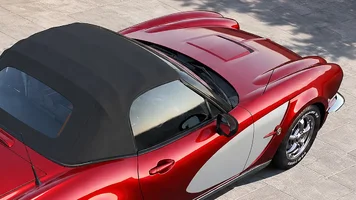
And if it is an MX-5 drive train and suspension, it will go like snot and handle great. 181 hp at 7000 rpms. And available with a 6 speed manual tranny.... A real manual.....with a third pedal.....
 
And if it is an MX-5 drive train and suspension, it will go like snot and handle great. 181 hp at 7000 rpms. And available with a 6 speed manual tranny.... A real manual.....with a third pedal.....
Not to mention it would be easier on fuel.
 
In 1967, Mercury decided to take road racing seriously. Enlisting NASCAR builder Bud Moore alongside driving legends Dan Gurney and Parnelli Jones, their factory backed Cougars battled Ford's own Shelby Mustangs across the Trans Am circuit. The team proved so fast that they missed the championship by a heartbreaking two points.

That success alarmed the boardroom in Dearborn. Ford could not afford to have its flagship pony car upstaged by its upscale sister division, so executives abruptly canceled Mercury's road racing budget after just one season.

Deprived of track glory, Mercury answered on the street with the 1970 Cougar Eliminator. Styled with a front chin spoiler, blacked out grille, and a bold rear wing, buyers could pack it with serious hardware, including the high revving Boss 302 or massive 428 Cobra Jet. It gave drivers genuine road capability wrapped in hidden headlight luxury, proving Mercury never lost its bite.

1790035772731.webp
 
Every 1935 Auburn Speedster left the factory with a metal plaque on the dash, signed by record driver Ab Jenkins, promising the car had exceeded 100 miles per hour before shipment. Buyers believed each one had been personally flogged on a measured mile. In truth the numbers on the plaques changed from car to car and nobody actually verified any of it.

The trick was that it probably wasn't a lie. Jenkins had taken one to Bonneville that January and set seventy records, averaging 102.9 mph for twelve solid hours, the first stock car in America to hold triple digits that long.

Under that sculpted tail sat a 280 cubic inch flathead eight with a centrifugal supercharger spun at six times engine speed, breathing through four chrome pipes out the side. Around 150 were ever built, each priced at $2,245 in the depths of the Depression
1790035939837.webp
 
Twenty seconds. That is all it took to turn the 1967 Firebird 400 into the car it was always meant to be.

Pontiac needed its new F-body fast, so engineers did the practical thing. They grabbed the exact 400 cubic inch engine from the GTO, bolted it between the Firebird's fenders, and rated it at 325 horsepower instead of 335. The engine was completely identical. Heads, cam, compression, all of it. The only difference was a small tab hidden in the throttle linkage that stopped the Quadrajet's secondaries from opening all the way.

A GM corporate rule capped output at one horsepower per ten pounds of weight, and the lighter Firebird would have humiliated the halo car that made Pontiac famous. So the tab stayed, at least until owners discovered that bending it took twenty seconds flat. The GTO kept its crown on paper. The Firebird quietly took it everywhere else.

1790037455538.webp
 
Chrysler's styling director Dick Macadam was appalled at the idea. Naming a muscle car after a cartoon bird was self mockery, and it would cost real money in licensing fees. Dealers disagreed, and dealers won. Plymouth paid Warner Bros 50,000 for the rights and another10,000 just to make the horn go beep-beep.

The punchline is that the bird humiliated the Judge on its own turf. Plymouth expected 20,000 buyers in 1968 and sold about 45,000. A year later it was Motor Trend's Car of the Year, and it was even outselling Plymouth's own plush GTX.

By 1970 the Road Runner had the party trick that still makes people grin at stoplights. Pull the dashboard switch and a vacuum servo slowly raises the Air Grabber scoop from the hood, revealing shark teeth decals. Underneath, you could order a 383, a 440 Six Barrel, or the 426 Hemi. Cheap, loud, and named after a bird that always wins
1790037605326.webp
 

Users who are viewing this thread

Back
Top