Vintage ads and articles - Corvette

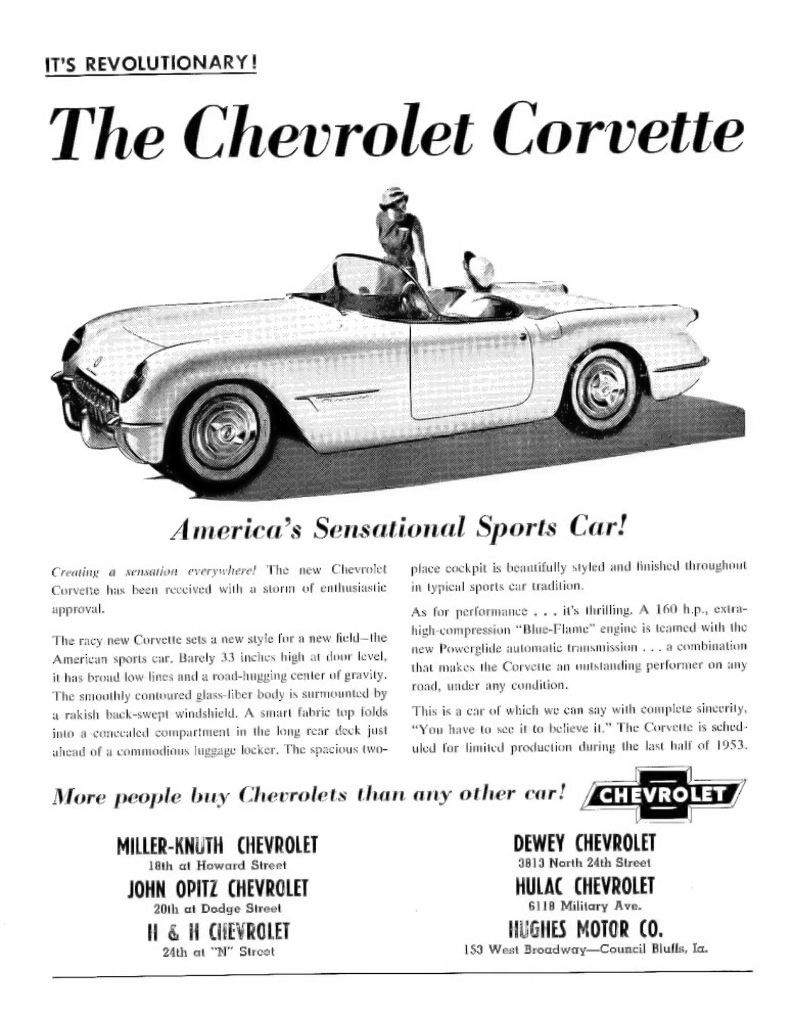
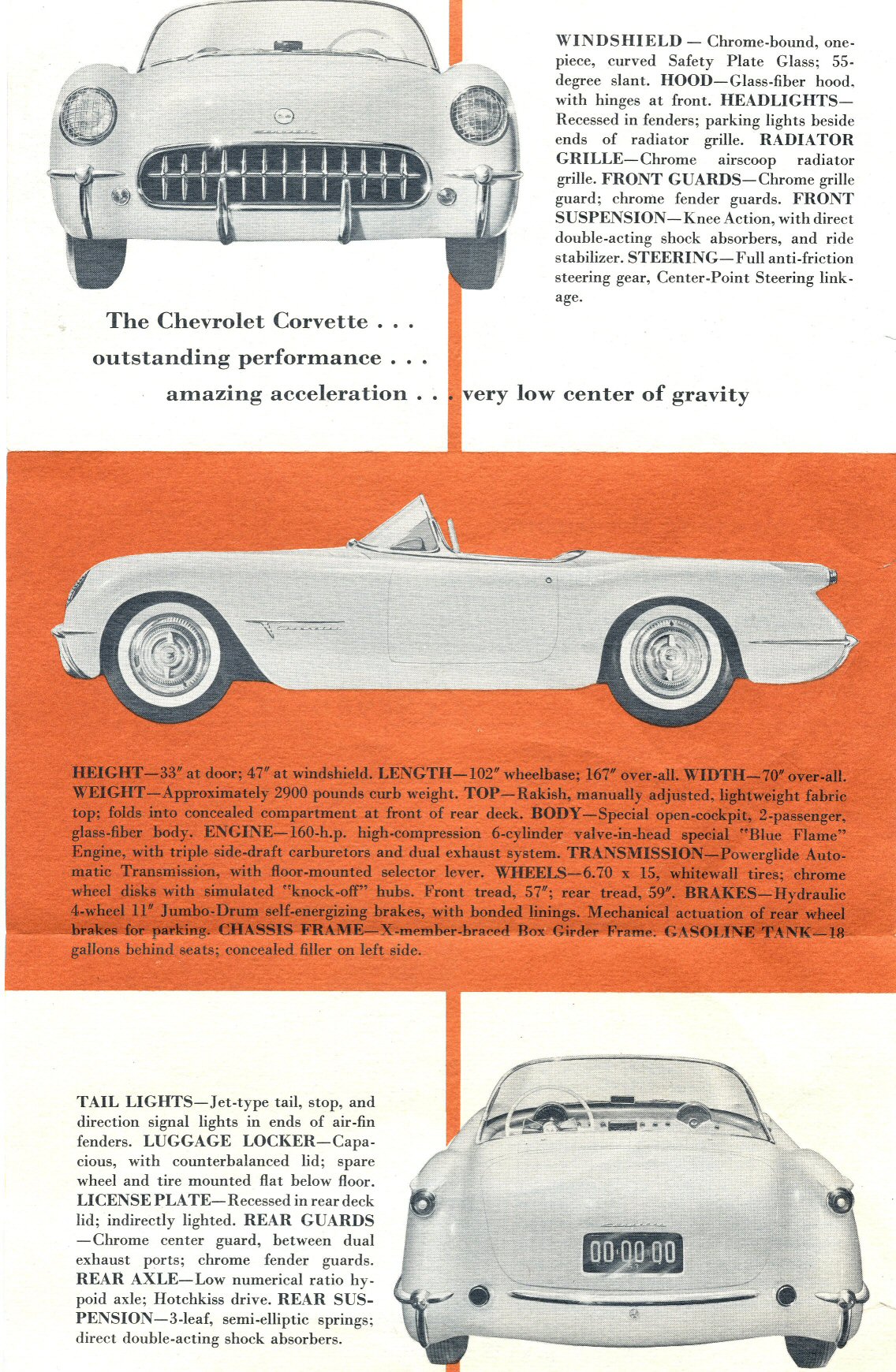
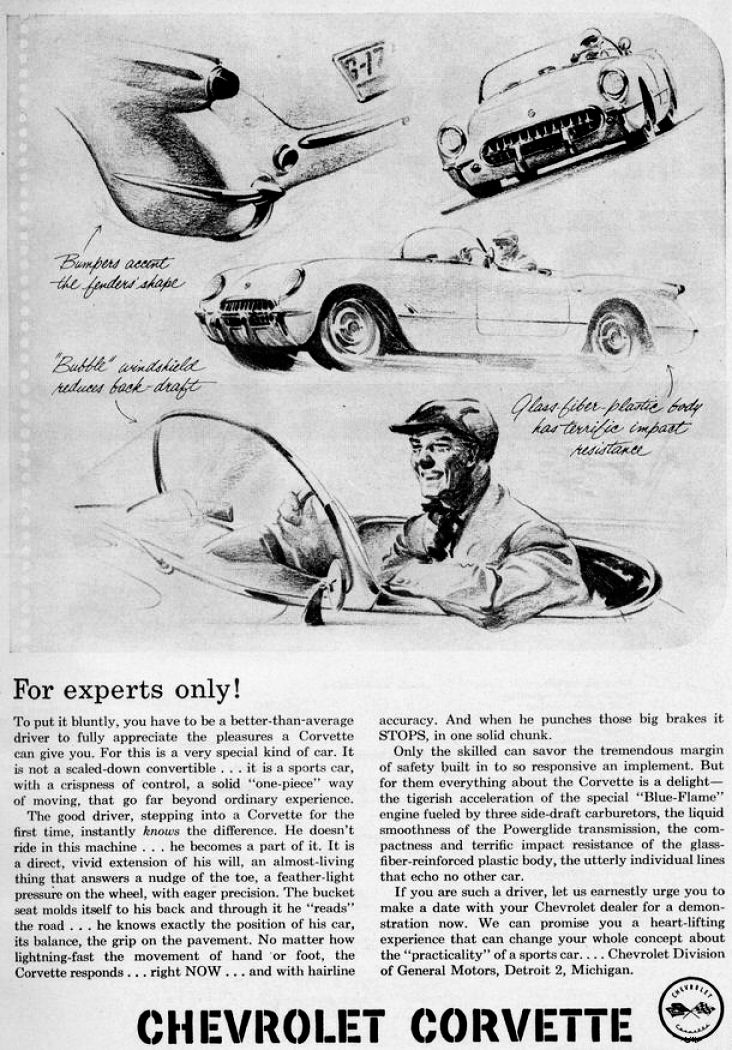
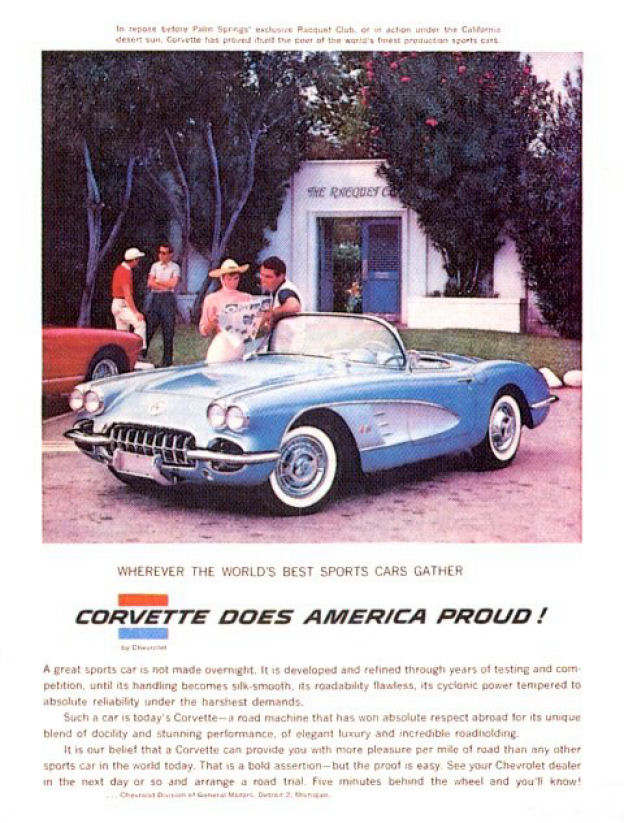
So I ran across some old Corvette ads today and enjoyed how Chevrolet described the car. Thought I would share. Would love to have some of these originals framed for the garage.

They actually use the word "swell" describing the new disc brakes :Woot:

Feel free to add what you guys have.

Enjoy

13c77ee454d41caa65cb4850219614ed.jpg


131db8b2cb9d527a30b672cac9094adb.jpg
 
This should be an interesting thread Derek. Not only the evolution of the Corvette but advertising as well. Great idea.
 
Some great information on the evolution of the C1
1953-Chevrolet-Corvette-nose.jpg

America’s favorite sports car in its early, formative years: 1953 to 1957. Next, color is a very useful car spotter’s aid with these early years of Corvette. There were two basic body styles in the ’53-’57 timeframe: the ’53 to ’55 and the ’56-57, and beyond that, the changes tend to be few and subtle. Paint and trim colors will help us sort out the years.

1953-Corvette-black-top.jpg

The first 300 production Corvettes for 1953, built in Flint, Michigan starting in June, were peas in a pod. All were essentially identical with Polo White exterior paint, red vinyl interior, black cloth convertible top, and red-painted wheels visible around the full wheel covers. These covers are unique to the Corvette; however, it seems that due to a supply issue, approximately 25 cars were equipped with dome-style ’53 Chevy passenger car wheel covers.

1953-Corvette-prototype-bridge.jpg

The first Corvette many Americans got to see was the New York Waldorf show car, aka EX-122, and there are plenty of photos around. Visually, the prototype is almost identical to the production car, but with a few differences that are easy to spot. The bright side trim does not run the length of the body, only for a short section of front fender behind the wheel house. Also, the Corvette badge and dart are beneath the chrome trim rather than above it. The Waldorf Corvette is still in existence today. Two additional prototypes were used as test mules and then destroyed, reportedly.

1954-Corvette-beige-top.jpg

For 1954, the Corvette was virtually identical but for some color changes. Most notably, the convertible top on all ’54 models was beige rather than black. This is the easiest way, from middle distance, to tell a ’54 Polo White Corvette from a ’53. While Polo White was by far the most common exterior color in ’54, Pennant Blue, Sportsman Red, and black paint were also offered. All had red interiors except the Pennant Blue cars, where beige was used. Only four black ’54 Corvettes were built, reportedly.

1953-Corvette-engine-.jpg

The earliest Corvettes used Chevrolet’s standard Stovebolt six with a few traditional hop-up aids, including a bump in compression, a sportier cam, and three Carter YH side-draft carbs. All 1953 models and the early 1954 models were equipped with these three very basic bullet-style air cleaners.

1954-Corvette-Blue-Flame-235-CID-Six-2.jpg

Midway in the 1954 model year, there was a running change from the three bullet-type air cleaners to a pair of conventional saucepan-style units. Chevy’s cast-iron, two-speed Powerglide automatic was the only transmission offered with the inline six.

1953-55-Corvette-right-rear.jpg

At the rear, the Corvette look for ’53 through ’55 featured these rocket aka bullet taillamps, through-the-body exhaust outlets, and recessed license plate housing with plastic cover. Note the ’53-’55 wheel cover with red paint detailing regardless of body color. Front and rear bumpers in these years were primarily decorations—they didn’t bolt to anything substantial underneath.

1955-Corvette-left-front-headlamp.jpg

Here’s the Corvette nose for ’53 through ’55, with its signature stone guard aka fencer’s mask headlamp surround. These stone guards alone make the ’53, ’54, and ’55 Corvettes difficult to confuse with anything else. The trick is telling them apart.

1955-Chevrolet-Corvette-Gordon-Duda.jpg

Styling remained unchanged for 1955 but there was a critical change under the hood: the brand-new small block V8 was now available, along with an optional three-speed manual transmission. The 265 CID V8 totally transformed the Corvette from a boulevard poseur into a real sports car.

1955-Corvette-V-emblem.jpg

Here’s the easy tell on the ’55: the gold V trim behind the front wheel signifying a 265 CID V8. Seven Corvettes were reportedly built with six-cylinder engines in ’55, but Corvette experts don’t believe any of them survive. The brilliant color shown here was called Gypsy Red, but Harvest Gold, Polo White, Pennant Blue, and Corvette Copper were also available. Interior vinyl colors were red, dark beige, light beige, and yellow.
1956-Corvette-brochure-red.jpg

Styling got a much needed overhaul for 1956, giving the Corvette a new visual identity to go with the muscular small-block V8. The toothy grille was retained, but the fencing mask headlamp nacelles were ditched. This was the first year for Corvette’s signature fender coves—on the ’56 and ’57, the coves are open at the front. The ’56 was also the first Corvette with roll-up side glass; previous models were true roadsters with pop-in windows.

1956-Corvette-painted-headlamp-ring.jpg

On the the first 500 ’56 Corvettes, the headlamp rings were painted body color. From then on, ’56 and ’57 models wore chrome lamp trim.

1956-57-Corvette-taillamp.jpg

Taillamp assemblies were identical in ’56 and ’57, and similar to ’58-60 but with a small vertical lens.

1956-Corvette-mirror.jpg

The ’56 and ’57 models are nearly indistinguishable in most ways, except for this odd little detail. The ’56 uses the thumb screw shown here to adjust the dash-mounted rear-view mirror. In contrast, the ’57 uses a jam nut on the mirror stalk. It’s not much, but the mirror is usually in easy view, and it makes a useful tell.

1957-Corvette-mirror.jpg

And here’s the 1957 mirror with a jam nut on the stalk for adjustment.


The first 500 ’56 Corvettes also wore their dipsticks on the right side of the engine, for what it’s worth.

1957-Corvette-silver.jpg

One new color for 1957 not available in ’56 was Inca Silver, shown here. Colors for ’57 were Onyx Black, Inca Silver, Aztec Copper, Cascade Green, Arctic Blue, Venetian Red. and Polo White.

1957-Corvette-FI-badge.jpg

Another way to distinguish the ’57 Corvette from the ’56 is at hand if the ’57 happens to be equipped with optional fuel injection, a new feature that year. Externally, the ’57 FI models carried these badges in the fender coves, with crossed flags and fuel injection script.

1957-Corvette-fuel-injection-.jpg

Tom McCahill of Mechanix Illustrated (left) and Zora Arkus-Duntov inspect the ’57 Corvette’s new fuel-injection system. A Borg-Warner four-speed manual gearbox also became available in ’57, further transforming the Corvette into a real, world-class sports car.


With mechanical fuel injection, the 283 CID Corvette V8 for 1957 developed 283 horsepower. The Rochester Ramjet unit carried its fuel meter on the right, the air meter and throttle body on the left, and the intake manifold plenum in the middle.
1957-Chevrolet-Corvette-rear-art.jpg

1956-Corvette-brochure-art-.jpg
 
Might as well start at the beginning....

1953%20Corvette%20Ad-03.jpg


1953-corvette-brochure-3.jpg
Vette-in-150.jpg


1953corvette_01.jpg


This is still true today..... amazing description that for us lucky Corvette owner is timeless.

1953%20Corvette%20Ad-02.jpg

1953-Corvette-Dealers-Brochure-5.jpg


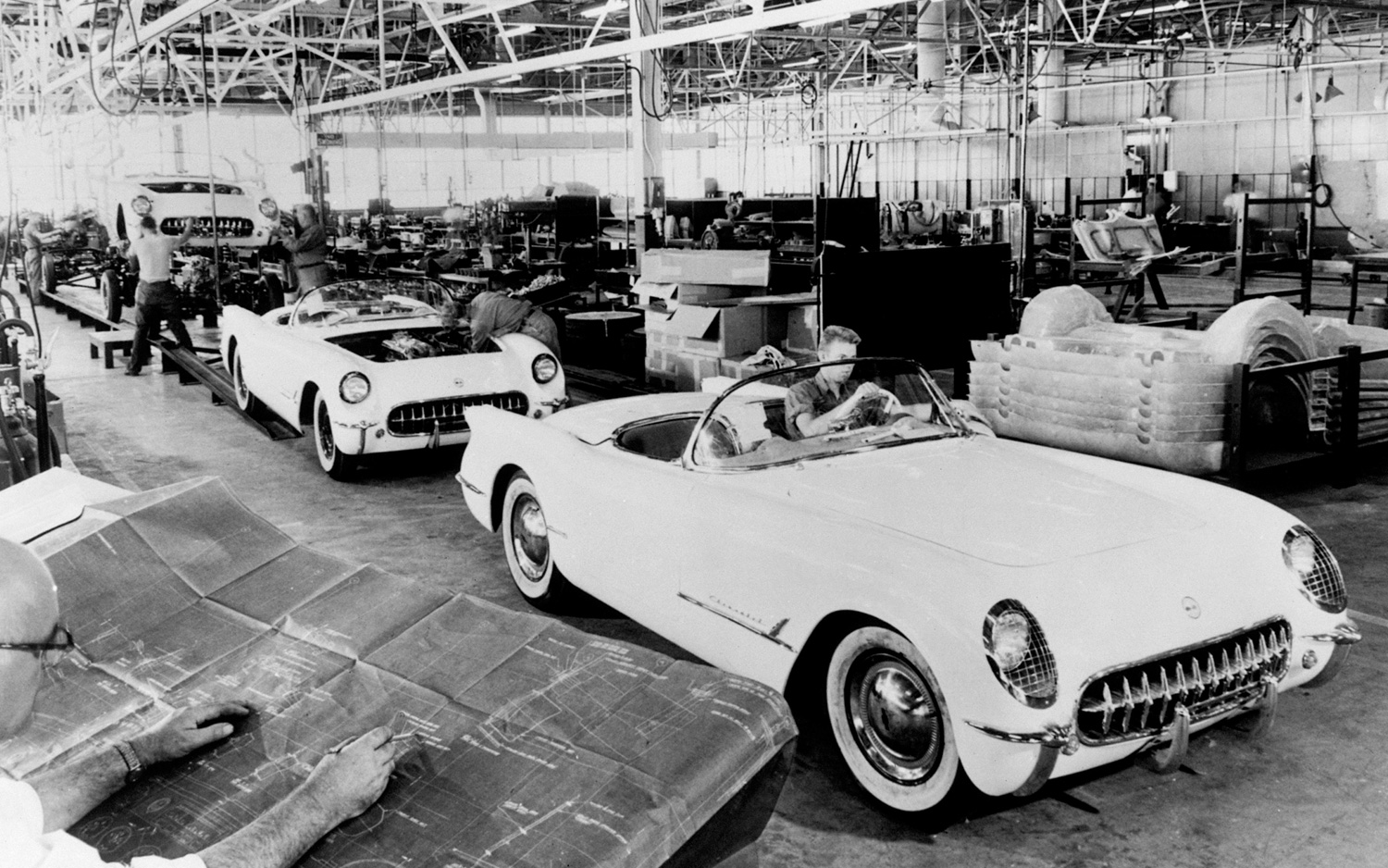
First one of 300 Corvettes built in 1953 for release. All were white.
1953-chevrolet-corvette-assembly-line.jpg
This same pic is in a few of the offices at Shaganappi,2 by 3 feet. I'm presently negotiating a copy of this and another one. That is number car number 1 right there. C1,car 1.
 
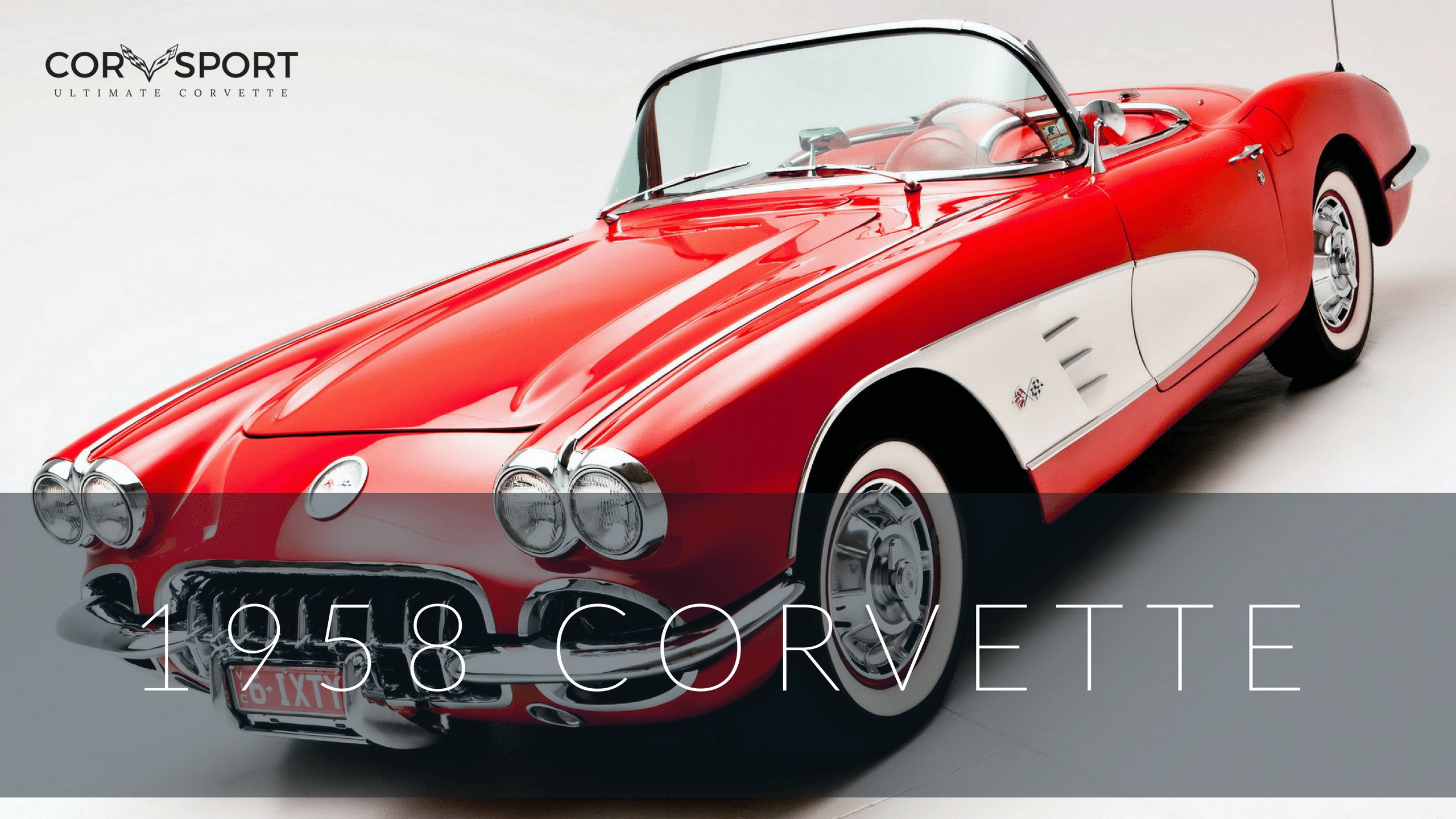
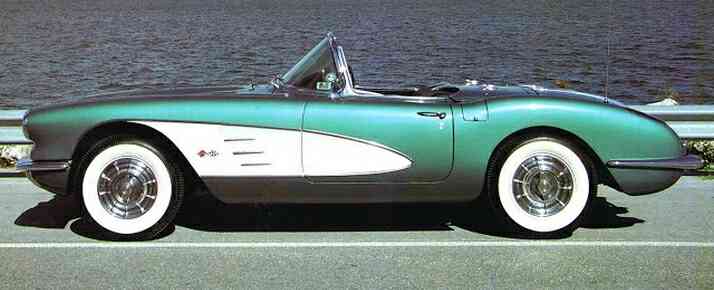
Today we move on to the 1958. While still a C1 there were some considerable changes to the Corvette.

Enjoy..

1953-corvette-5.png


By the late 1950’s, the infrastructure of the automotive industry had begun a transformation from the monopolistic business of a few, large, corporate giants to a much more competitive and highly segmented marketplace. A few small, relatively unknown companies from Europe were emerging, presenting competitively priced alternatives to the current American offerings, catching companies like Ford and General Motors completely by surprise. Volkswagen had introduced the Beetle and confounded the competition by selling 200,000 or more units per year. The introduction of this, and other “cheap” cars into the automotive market would forever change the direction of automotive marketing and would directly impact the future of the Corvette.

Model: 1958 Corvette
Generation: C1 Corvette
Type: 2 Door Convertible
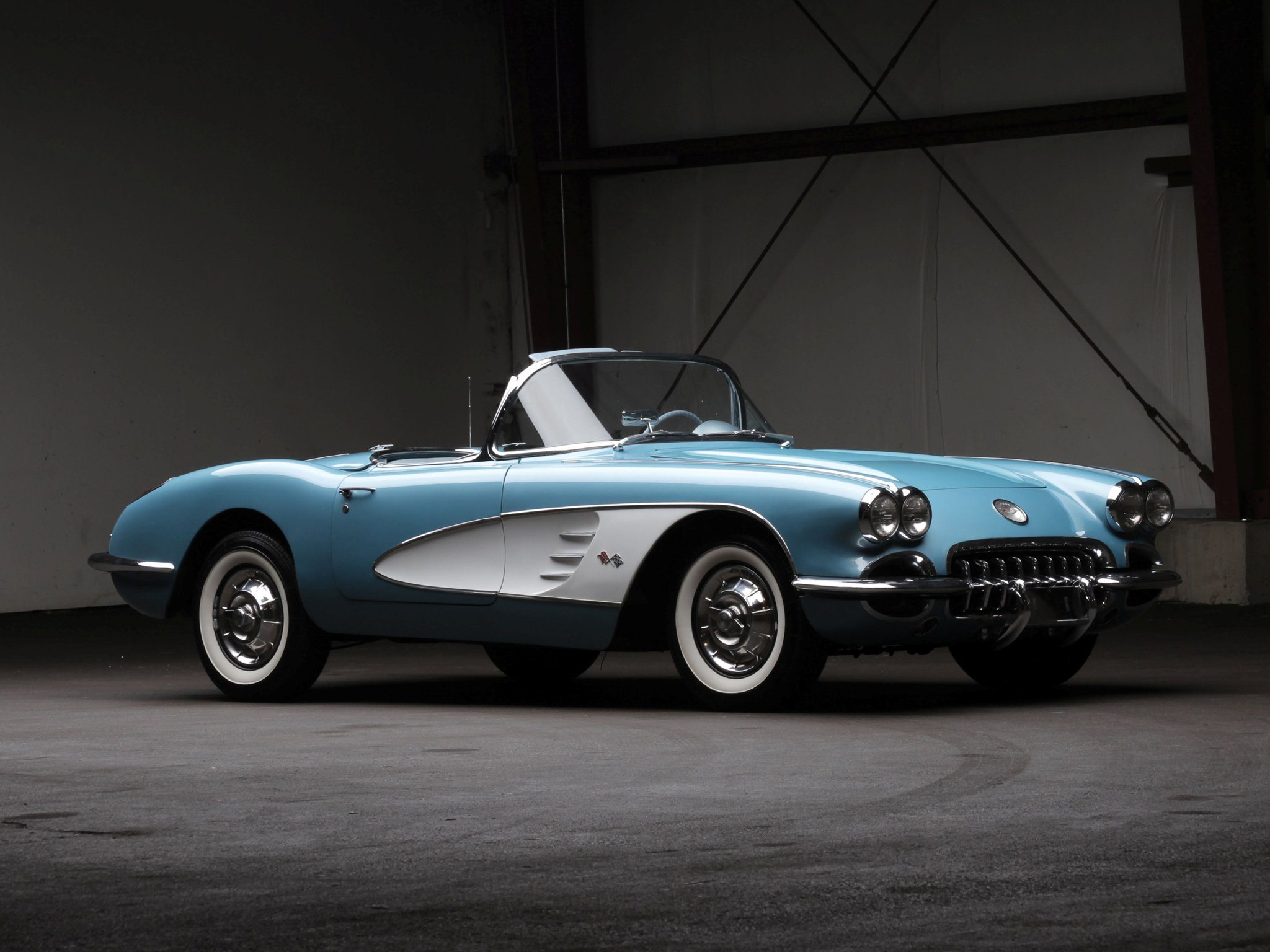
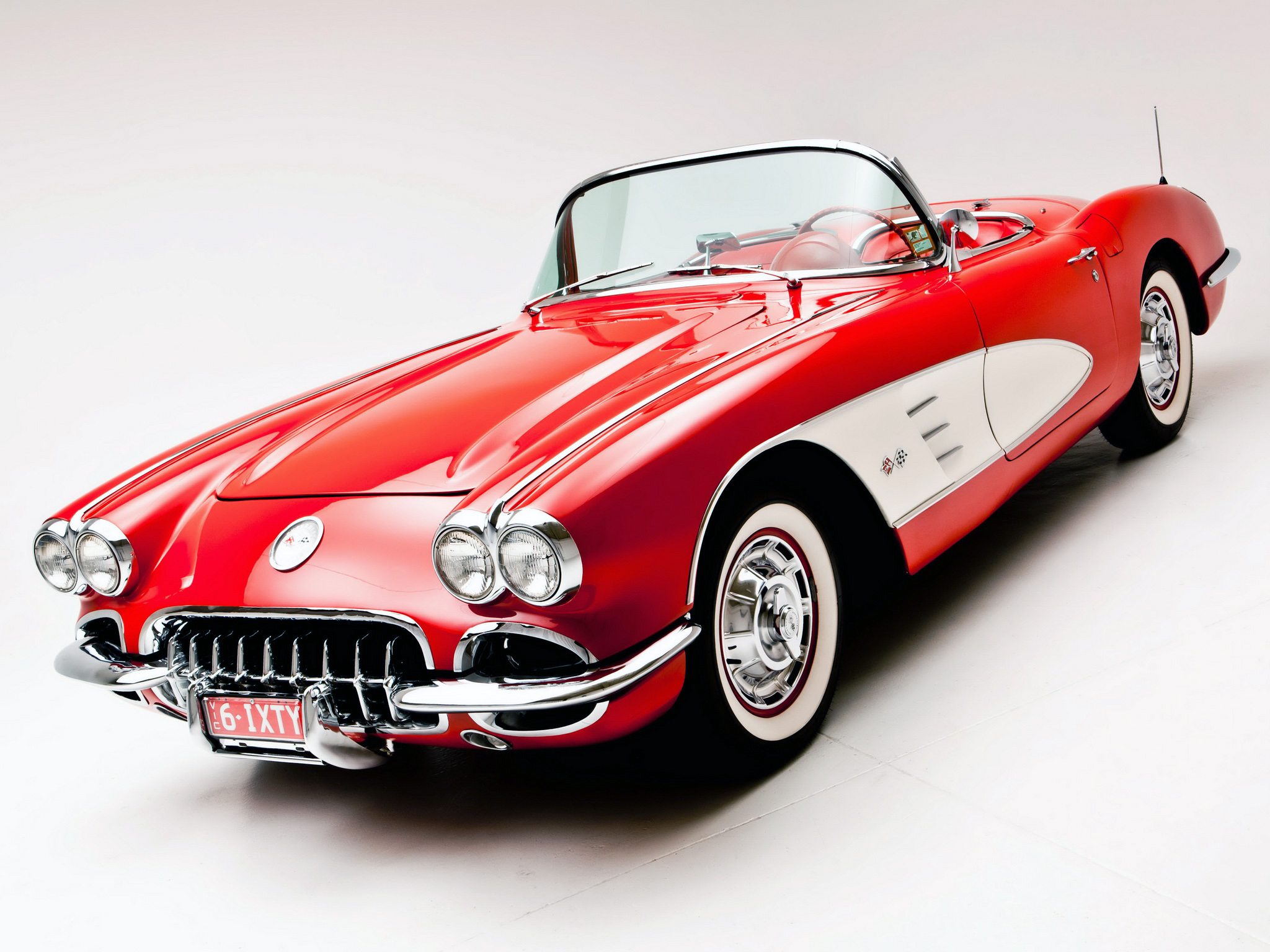
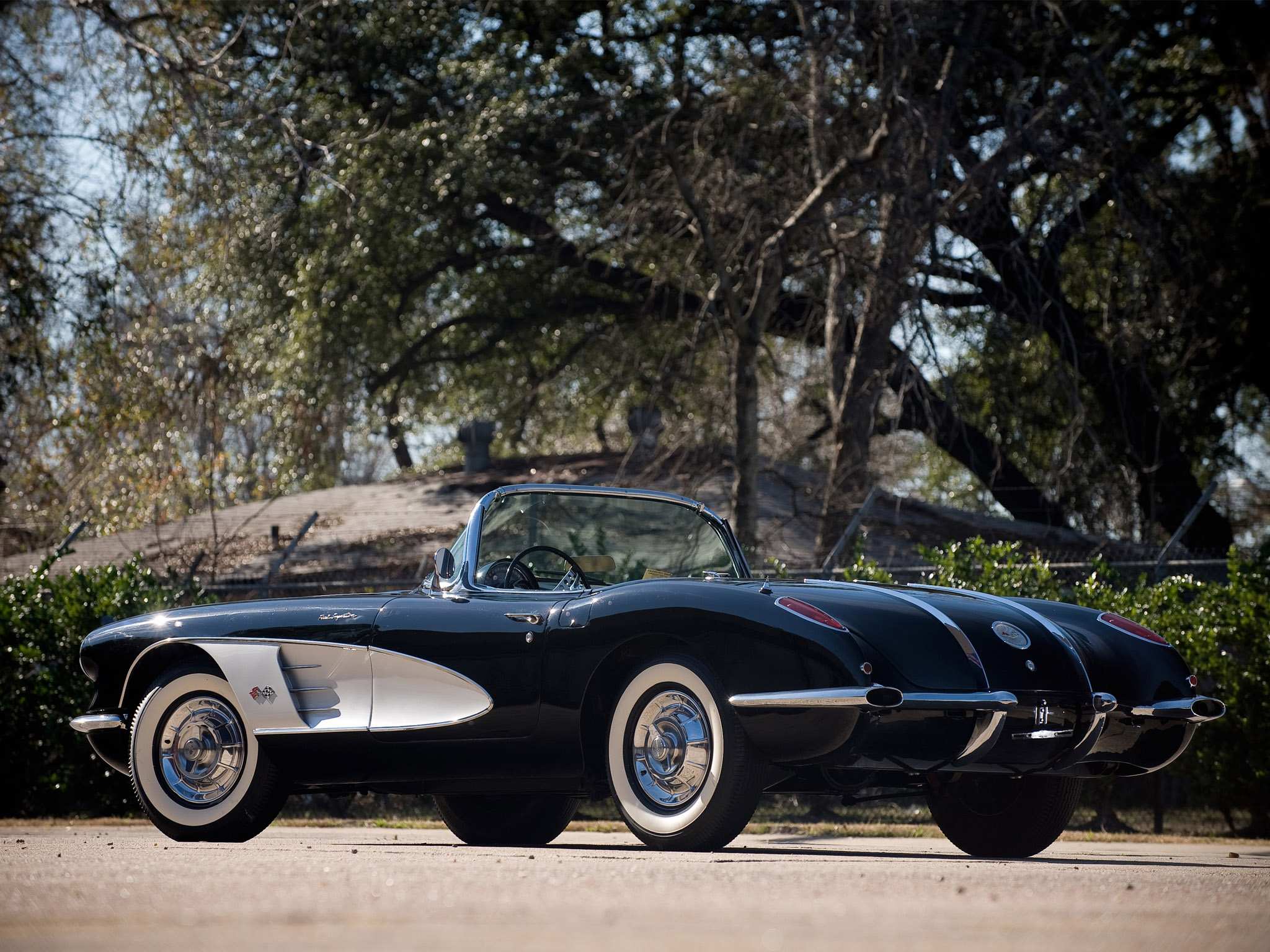
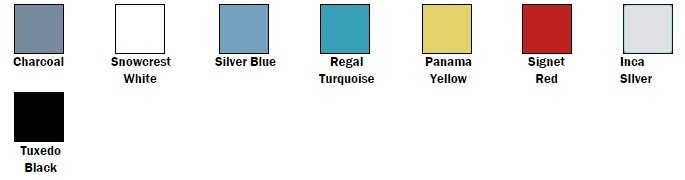
Available Colors: Charcoal, Silver Blue, Panama Yellow, Tuxedo Black, Snowcrest White, Regal Turquoise, Signet Red, Inca Silver
Engine: 283 ci. V-8 (fuel injected or carbureted) – multiple-horsepower options available
VIN: J58S100001 – J58S109168
Transmission: 3-speed manual (standard), 4-speed manual (optional), 2-speed Powerglide (optional)
Original Price: $3591.00
Units Produced: 9,168


Despite the fact that the Corvette had yet to be profitable, General Motors management was certain that the design changes that Harley Earl had implemented in his 1956 redesign would continue to be the basis of design for future model years. Certainly, the 1957 Corvette had shown considerable improvement in it’s numbers over the 1956 model year and, if things continued to move in that same direction, the Corvette would certainly meet financial success in the coming year.
In addition, Corvette had managed to completely dominate on the racetrack and, despite the fact that General Motors would join others in observing the racing ban that had been put in place by the Automobile Manufacturer’s Association (AMA), it had proven nearly unbeatable in it’s class.
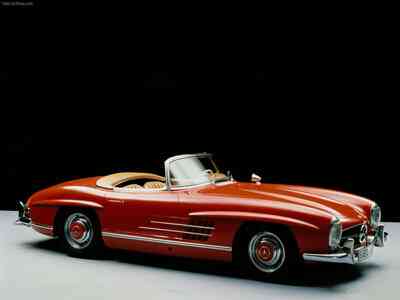
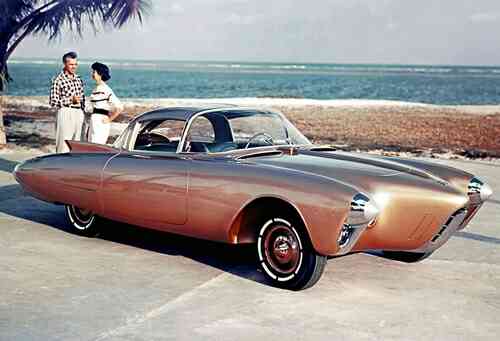
It is commonly believed that the Corvette had performed so well in open competition throughout 1957 that it had forced Ford to “throw in the towel” on it’s two-seater Thunderbird, forcing them toStill, GM engineers were entertaining thoughts of unit-body construction, while the styling staff was drawing inspiration from the design styling of the immensely popular Mercedes-Benz 300SL gullwing coupe. Drawing on inspiration from both Earl’s ‘56 Corvette and the Mercedes-Benz, a new concept car emerged that was featured at the 1956 Motorama that nearly became the basis for an all-new Corvette. This car would go on to become known as the “Oldsmobile Golden Rocket”.
This “Golden Rocket” was a unit-body, two seat coupe that sported futuristic styling that included a slim vertical grille and a protruding snout with quad headlamps – a style that was immensely popular amongst designers in Detroit.
The Oldsmobile’s front fenders swept back the length of the body to a torpedo like rear end that was topped by small fins. Gullwing-like sections were cut into the roof assembly to allow greater ease when entering/exiting the car. Much like the rest of the car, the roofline also tapered back in a “boattail” fashion, with a large rear window that wrapped down and around the roof.

In all, the “Oldsmobile Golden Rocket” would become commonly recognized as the inspiration for Bill Mitchell’s Corvette Stingray seven years later.


1-2.jpg

The 1957 Mercedes Benz 300SL

2-7.jpg

The Oldsmobile “Golden Rocket” Concept Car (image courtesy of GM Media.)

As early as 1946, General Motors executives had come to a consensus that unit-body construction would be the path forward for cheaper unit cost and higher volume, both of which were items that Corvette needed to begin turning a profit. Using the Oldsmobile concept car as a model, engineers began laying out a new Corvette based on the Golden Rocket’s styling.
3-7.jpg

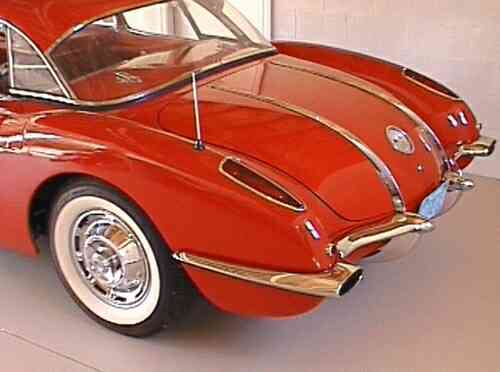
The rear chrome “suspenders” that are a key identifier of the 1958 Corvette.
Early models made of clay and fiberglass showed how unit body construction might help pave the way for a whole new era of Corvettes. Smaller and lighter than the current C1, it also compensated for many of the current design constraints that current Corvette engineers were forced to deal with.
However, this first pass at a new Corvette design never completely got off the ground. The project, which carried the name Q-Corvette, ended up getting shelved as members of the Concept Corvette development team were pulled away to other projects that demanded the attention of those who could best help in the ever increasing sales race against Ford.
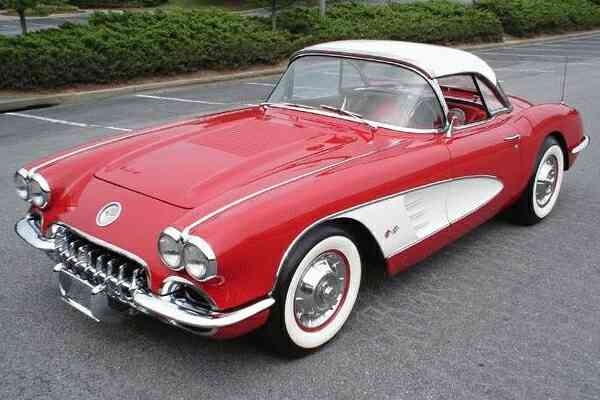
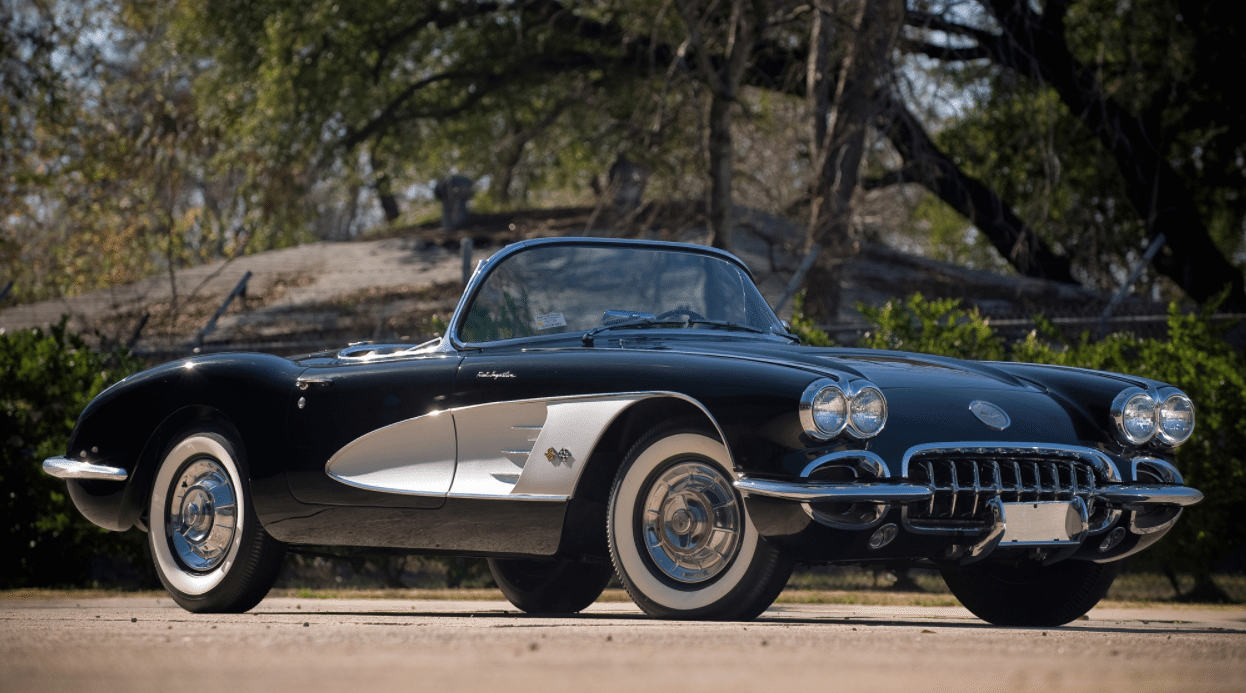
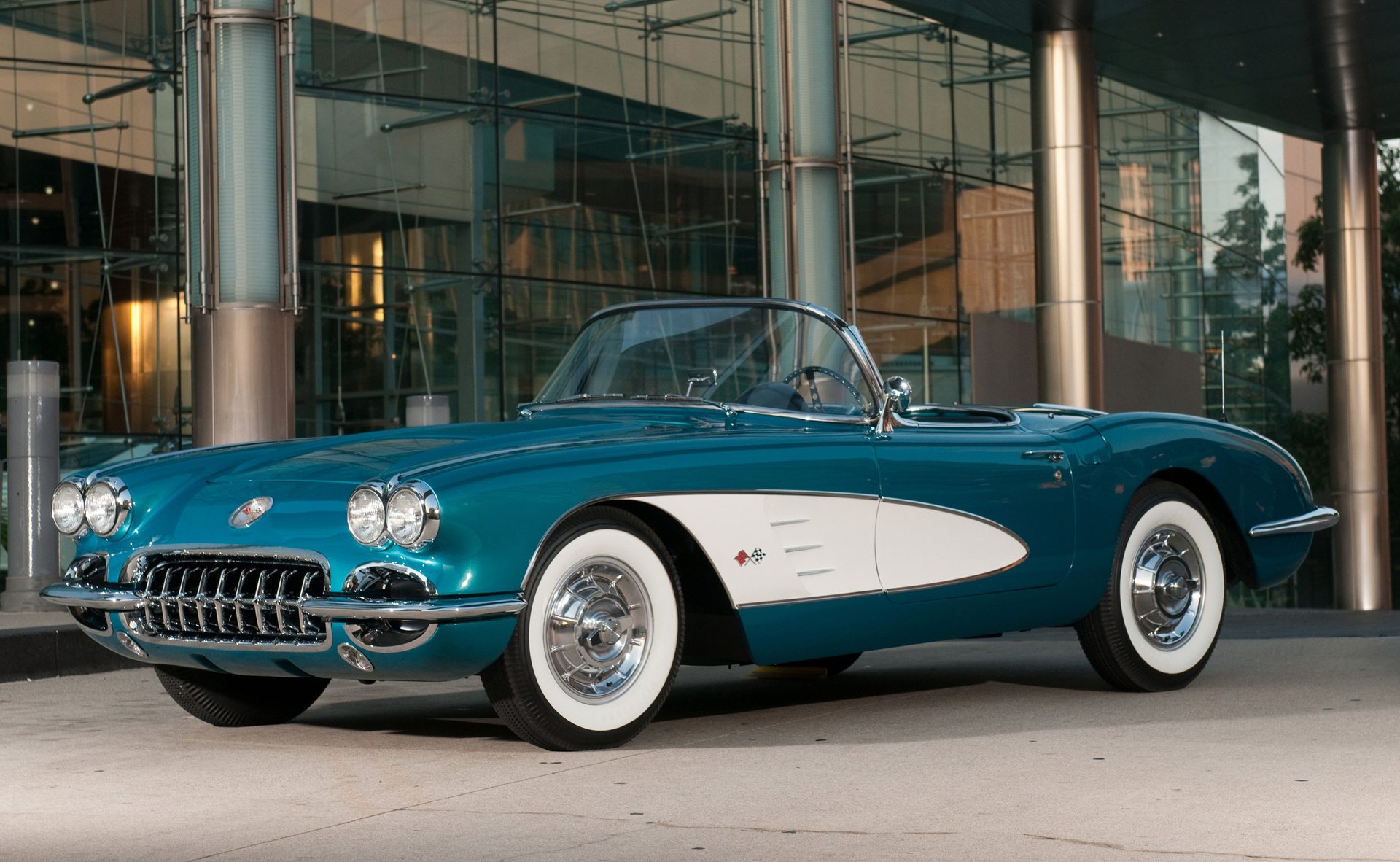
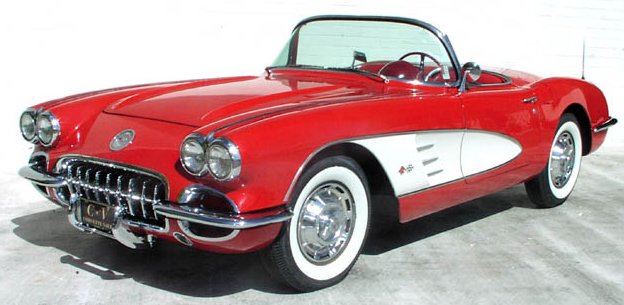
As far as the 1958 Corvette was concerned, the car would have to settle for a facelift. From the standpoint of appearance, the 1958 Corvette was far more excessive than any of it’s predecessors. While the car still reflected the design changes implemented in the 1956 and 1957 models, the ‘58 Corvette now sported simulated louvers on it‘s bonnet(hood), non functional air intake scoops on either side of the grille and phony vents in the bodyside “coves”. It also featured twin, chrome “suspenders” that ran from the base of the rear window down the trunk lid, before ending abruptly at the rear fender. Another notable departure from the earlier models was the addition of quad headlamps wrapped in a thick chrome bezel.

DID YOU KNOW:
As early as 1958, Chevrolet began developing the XP-700 Corvette as a prototype for the second generation ‘Vette.
This concept model Corvette featured many styling elements that GM’s new design Chief, Bill Mitchell, believed would represent the future of the Corvette.

Much like the chrome “suspenders” featured on the trunk lid, chrome strip ran along the tops of the fenders, accentuating the appearance of the headlamps and giving an overall “swept back “ appearance. Lastly, the chrome “teeth” in the front grille itself were reduced from thirteen (as had been the standard in all Corvettes prior to 1958) to only nine. The 1958 Corvette not only looked heavier with it’s many new additions and design changes, but it had actually gotten heavier.
4-3.jpg

1958 Corvette Front End with quad headlamps and faux hood louvers.
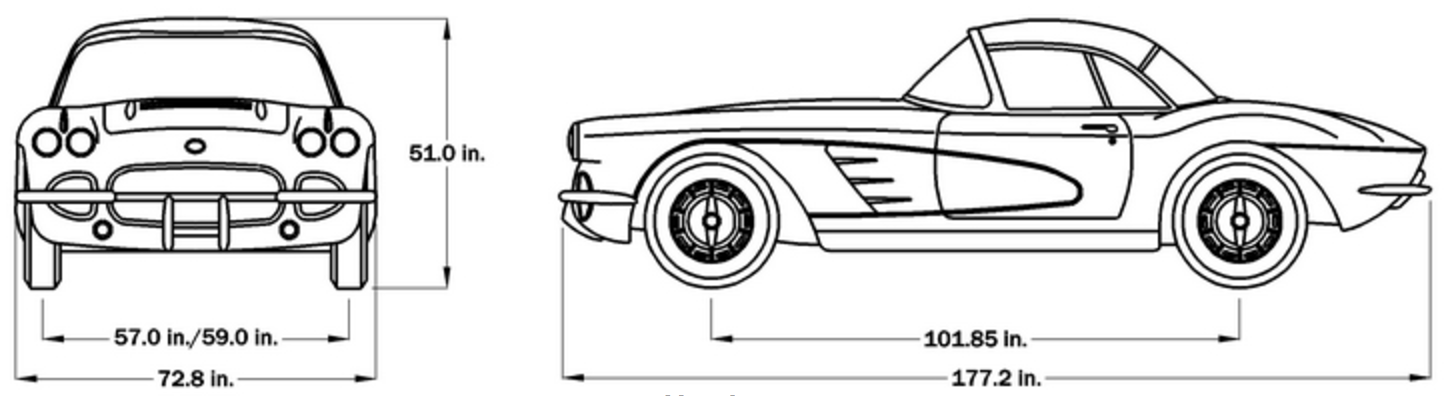
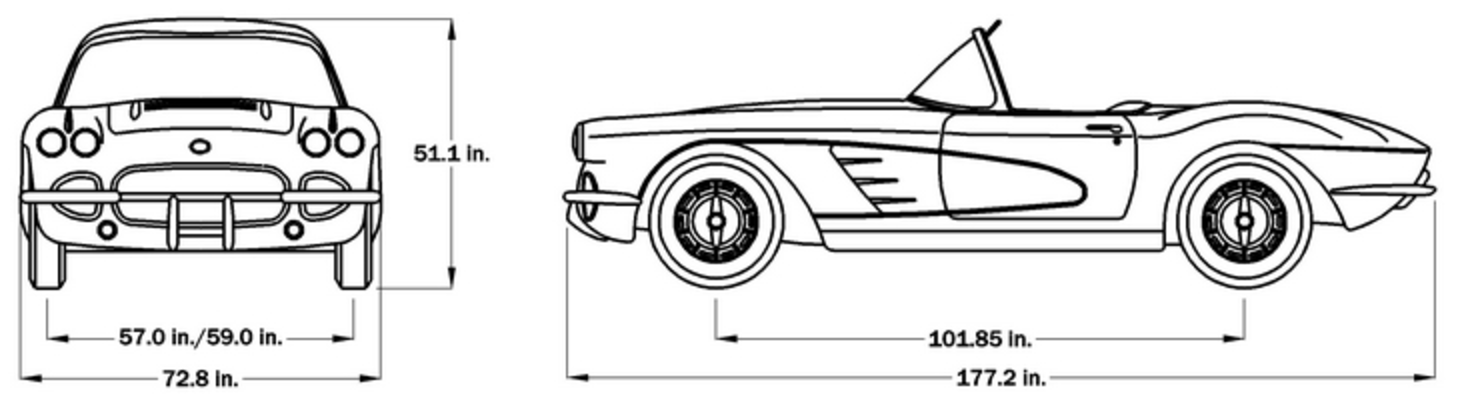
For the first time in Corvette history, the car exceeded 3,000 pounds, which was an increase of 200 pounds over the 1957 model. However, the increase in weight was not merely due to the excesses that were included in the car’s makeover, but was the result of the increased size of the car. The 1958 Corvette had 9.2 inches of added length and 2.3 inches of added width, bringing the car’s overall dimensions to 177.2 by 72.8 inches.
Because of the increase in weight and size, the Corvette would require the addition of radius rods to the rear suspension, which would help offset some of the behavioral issues the car experienced under hard acceleration conditions.
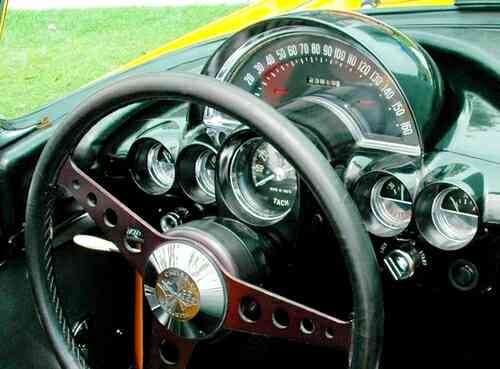
While the exterior revisions to the 1958 Corvette exuded excess from almost every angle, the interior revisions to the car were no less substantial, although they were better received. A significant redesign of the instrument cluster at the request/direction of Zora Arkus-Duntov resulted in all of the gauges (save for the clock) to be placed directly in front of the driver in a binnacle. After the repeat criticisms of instrument placement in earlier models, this change seemed only natural to the Corvette’s design team. The new cluster consisted of a 160-mph speedometer which dominated most of the dashboard, while a smaller 6000 rpm tachometer was placed ahead of it on the steering column. Flanking the tachometer on each side was a pair of standard instrument gauges that monitored fuel levels, oil pressure, engine temperature and battery charge.

5-3.jpg

1958 Corvette’s Re-Designed Instrument Cluster.
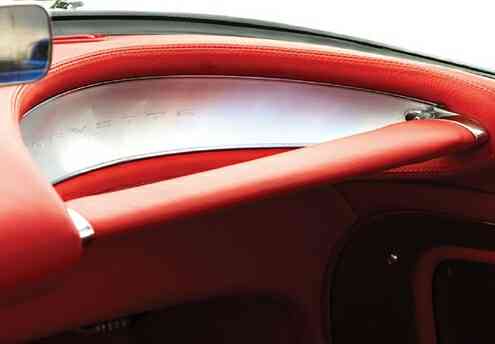
Emerging from the dashboard and mating with the center console was a narrower, vertical console which housed the heater controls, the clock and an optional “Wonder Bar” signal-seeking radio. While relatively unique for it’s time, this arrangement of controls was virtually identical to the standard layout in automobiles today. The passenger side of the dashboard featured a grabbar mounted in front of a semicircular dashboard that was cut away from the bar itself, allowing passengers to “hold on” in the event of a sharp turn or during sudden acceleration.

A locking glove compartment was fitted between the seats just below the release button for the convertible top. Other changes were made to the interior as well. The interior door panels were remodeled to include reflectors that had been added at arm level for nighttime safety. Upholstery now featured a new “pebble grain” fabric. Even seatbelts, which had been practically unheard of before that model, were standard issue – factory installed in the 1958 Corvette.

6-3.jpg

1958 Corvette Dashboard Passenger Side Grab-Bar.
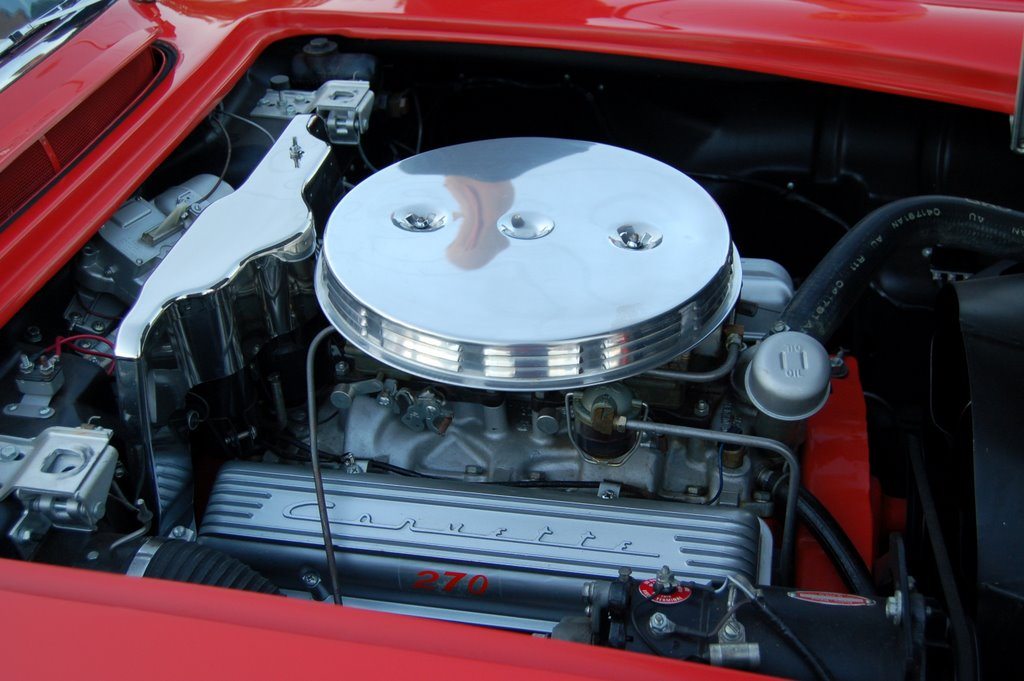
Regardless of personal opinion surrounding the 1958 Corvette’s appearance, there were no questions what the performance factor would be. Nearly unchanged from the 1957 Corvette, the ‘58 continued to utilize the 283 engine. Now officially rated at 290 horsepower (at 6,200 rpm’s), the fuel injected, Duntov-cam 283 continued to flourish beneath the hood of the 1958 Corvette as the top level engine for that year’s model run.
Similarly, a twin carburetor version of the engine continued to be offered as an option, offering drivers an uncompromising 270 horsepower engine. Despite this fact, few buyers opted for the carbureted version of this engine. Surprisingly, it was the base level 230 horsepower V-8 engine that buyers sought out. This base model engine was installed in nearly half of the 1958 models. Only 1,500 Corvettes were actually fitted with the fuel injection option, and of those only 1,000 featured the 290 horsepower setup, the other 500 belonging to the 250 horsepower version of the Corvette.
For those enthusiasts that had continued to demand uncompromising speed and performance after the introduction of the 1958 model, Chevrolet continued to offer a near race-ready version of the Corvette, which they made available at local dealerships across the country – and at prices that made buying even the highest end Corvette affordable. With upgrades ranging from a high performance, 290 horsepower, fuel injected engine, Positraction, heavy-duty metallic brake and suspension and a four speed manual transmission, the total difference in cost between the base priced Corvette and it’s racing counterpart was about $1500.00.
Considering that these upgrades allowed the ‘58 Corvette to rival such competitors as Jaguar, Ferrari and Porsche, there was no question that Corvette was the best performance for the price. It is reported that Corvette’s which were built to include the aforementioned upgrades came with a warning label on their windshields that stated “This car is not intended for street use.”
Despite some of the extreme changes to it’s body styling, the 1958 Corvette was the first vintage of Corvette to turn a profit for General Motors.

7-4.jpg

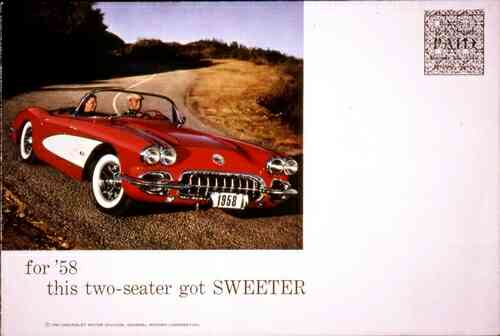
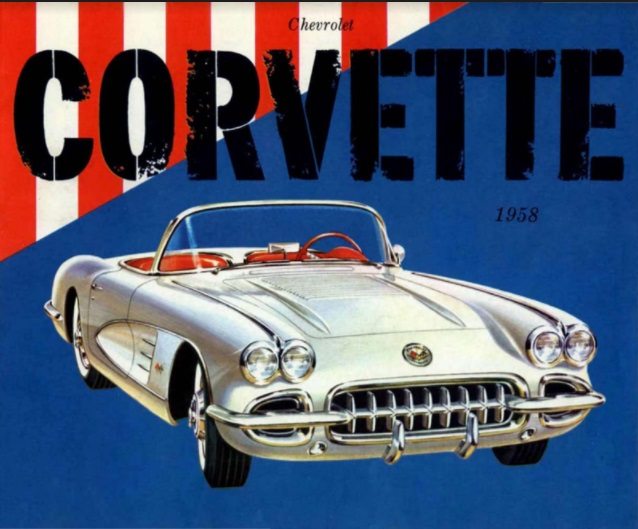
An Original 1958 Corvette Mailer (Distributed by GM in 1958.)
In all, Chevrolet sold 9,168 Corvettes in the 1958 model year, which was doubly impressive when considering that the Corvette sales were up (47% over the 1957 Corvette and a staggering 150% over the 1956 Corvette) despite a year in which a financial recession had wrought havoc on the competition, leaving few manufacturers to actually turn a profit that year. In fact, save for Ford’s new four-seat 1958 Thunderbird (and very few others), Corvette alone proved successful in the domestic automotive market.


Part 2: 1958 Specs


1958 CORVETTE – SPECIFICATIONS
1958 CORVETTE MAIN SPECS
MODEL: 1958 Chevrolet Corvette
BODY STYLE: Two-door convertible, front engine, rear wheel drive
MANUFACTURING LOCATION: St. Louis, Missouri
CONSTRUCTION: Fiberglass Reinforced Plastic (FRP or “fiberglass”) body, steel frame with steel and chrome structural & chassis components.
VEHICLE NUMBERS (VIN): J58S100001 – J58S109168
VIN PREFIX: CQ: 283 CUBIC INCH, 230 HORSEPOWER, MANUAL TRANSMISSION
CR: 283 CUBIC INCH, 250 HORSEPOWER, MANUAL TRANSMISSION
CS: 283 CUBIC INCH, 290 HORSEPOWER, MANUAL TRANSMISSION
CT: 283 CUBIC INCH, 245 HORSEPOWER, MANUAL TRANSMISSION
CU: 283 CUBIC INCH, 270 HORSEPOWER, MANUAL TRANSMISSION
DG: 283 CUBIC INCH, 230 HORSEPOWER, AUTOMATIC TRANSMISSION
DH: 283 CUBIC INCH, 250 HORSEPOWER, AUTOMATIC TRANSMISSION
DJ: 283 CUBIC INCH, 245 HORSEPOWER, AUTOMATIC TRANSMISSION
ENGINE BLOCK NUMBER: 3737739, 3756519, 3748770
HEAD NUMBER: 3725306: 265 CUBIC INCH, 210 HP, 225 HP (2-BOLT EXHAUST MANIFOLDS)
3731762: 265 CUBIC INCH, 225 HP, 240 HP (3-BOLT EXHAUST MANIFOLDS)
CARBURETOR NUMBERS: CARTER 2613S [HASHTAG]#3741089[/HASHTAG]: 283 CUBIC INCH, 270 HP, FRONT CARBURETOR
CARTER 2614S [HASHTAG]#3741090[/HASHTAG]: 283 CUBIC INCH, 270 HP, REAR CARBURETOR
CARTER 2626S [HASHTAG]#3744002[/HASHTAG]: 283 CUBIC INCH, 245 HP, FRONT CARBURETOR
CARTER 2627S [HASHTAG]#3744004[/HASHTAG]: 283 CUBIC INCH, 245 HP, REAR CARBURETOR
CARTER 2669S [HASHTAG]#3746384[/HASHTAG]: 283 CUBIC INCH, 230 HP
FUEL INJECTION NUMBER: ROCHESTER 7014800: 283 CUBIC INCH, 250 HP
ROCHESTER 7014800R: 283 CUBIC INCH, 290 HP, EARLY PRODUCTION
ROCHESTER 7014900: 283 CUBIC INCH, 250 HP
ROCHESTER 7014900R: 283 CUBIC INCH, 290 HP
ROCHESTER 7014960: 283 CUBIC INCH, 290 HP
ROCHESTER 7017200: 283 CUBIC INCH, 250 HP, LATE PRODUCTION
DISTRIBUTOR NUMBER: 1110890: 283 CUBIC INCH, 230 HORSEPOWER
1110891: 283 CUBIC INCH, 245 HORSEPOWER, 270 HORSEPOWER
1110908: 283 CUBIC INCH, 290 HORSEPOWER, EARLY PRODUCTION
1110914: 283 CUBIC INCH, 290 HORSEPOWER
1110915: 283 CUBIC INCH, 250 HORSEPOWER
GENERATOR NUMBER: 1102043: 283 CUBIC INCH, 230 HP, 245 HP, 250 HP, 270 HP
1102059: 283 CUBIC INCH, 290 HORSEPOWER
AXLE IDENTIFICATION NUMBER AH: 3-SPEED MANUAL TRANSMISSION (3.70:1 RATIO)
AE: POWERGLIDE AUTOMATIC TRANSMISSION (3.55:1 RATIO)
AN: LIMITED SLIP DIFFERENTIAL (3.70:1 RATIO)
AP: LIMITED SLIP DIFFERENTIAL (4.11:1 RATIO)
AQ: LIMITED SLIP DIFFERENTIAL (4.56:1 RATIO)
AS: LSD, HEAVY DUTY SUSPENSION AND BRAKES, (3.70:1 RATIO)
AT:LSD, HEAVY DUTY SUSPENSION AND BRAKES, (4.11:1 RATIO)
AU:LSD, HEAVY DUTY SUSPENSION AND BRAKES, (4.56:1 RATIO)
PRODUCTION ENDING VEHICLE: OCT, 1957: 100486, NOV, 1957: 101443, DEC, 1957: 102511, JAN, 1958:103677, FEB, 1958: 104789, MAR, 1958: 105779, APR, 1958: 106544, MAY, 1958: 107489, JUN, 1958: 108192, JUL, 1958: 108840, AUG, 1958: 109168, MAY, 1958: 107489
1958 CORVETTE PRICE & OPTIONS
CODE DESCRIPTION QUANTITY RETAIL PRICE
867 Base Corvette Convertible 9,168 $3,591.00
101 Heater 8,014 $96.85
102 AM Radio, signal seeking 6,142 $144.45
107 Parking Brake Alarm 2,883 $5.40
108 Courtesy Lights 4,600 $6.50
109 Windshield Washers 3,834 $16.15
276 Wheels, 15 x 5.5 (5) 404 $0.00
290 Whitewall Tires, 6.70 x 15 7,428 $31.55
313 Powerglide Automatic Transmission 2,057 $188.30
419 Auxiliary Hardtop 5,607 $215.20
426 Power Windows 649 $59.20
440 Two-Tone Paint Combination 3,422 $16.15
469 283ci, 245HP Engine (2×4 Carburetors) 2,436 $150.65
469C 283ci, 270HP Engine (2×4 Carburetors) 978 $182.95
473 Power Operated Folding Top 1,090 $139.90
579 283ci, 250HP Engine (Fuel Injection) 504 $484.20
579D 283ci, 290HP Engine (Fuel Injection) 1,007 $484.20
677 Positraction Rear Axle, 4.56:1 1,123 $48.45
678 Positraction Rear Axle, 4.11:1 2,518 $48.45
679 Positraction Rear Axle, 4.56:1 370 $48.45
684 Heavy Duty Racing Suspension 144 $780.10
685 4-Speed Manual Transmission 3,764 $215.20
1958 CORVETTE EXTERIOR/INTERIOR COLOR
COLOR CODES
Exterior Total Body Cove (Optional) Soft Top Wheels Interior Colors
Charcoal 1,631 Inca Silver Black, White Silver Charcoal, Blue-Grey, Red
Snowcest White 2,477 Inca Silver Black, White, Blue-Gray Silver Charcoal, Blue-Grey, Red
Silver Blue 2,006 Inca Silver Black, White Silver Charcoal, Blue-Grey
Regal Turquoise 510 Snowcrest White Black, White Silver Charcoal
Panama Yellow 455 Snowcrest White Black, White Silver Charcoal
Signet Red 1,399 Snowcrest White Black, White Silver Charcoal, Red
Tuxedo Black 493 Inca Silver Black, White Silver Charcoal, Red
Inca Silver 193 – Black, White Silver Charcoal, Red
EXTERIOR COLOR TEMPLATES
Screenshot_2-4.jpg


INTERIOR COLOR TEMPLATES
Screenshot_3-4.jpg

1958_Corvette_Convertible_engine.jpg


1958 CORVETTE POWERTRAIN SPECIFICATIONS
Description 4-barrel Carb Dual Carb Dual Carb w. Special Cam Fuel Injection
Fuel Injection w. Special Cam
Standard RPO 469 RPO 469C RPO 469C RPO 579D
Type: 90 V 90 V 90 V 90 V 90 V
Number of Cylinders 8 8 8 8 8
Displacement (cid): 283 283 283 283 283
Horsepower (gross @ rpm): 230hp @ 4,800 245hp @ 5,000 270hp @ 6,000 250hp @ 5,000 290hp @ 6,200
Torque (lbs.-ft. @ rpm): 300 @ 3,000 300 @ 3,800 285 @ 4,200 305 @ 3,800 290 @ 4,400
Bore Spacing (C/L to C/L) 4.4 inches 4.4 inches 4.4 inches 4.4 inches 4.4 inches
Bore x stroke (in.): 3.875 x 3.00 3.875 x 3.00 3.875 x 3.00 3.875 x 3.00 3.875 x 3.00
Redline (rpm): – – – – –
Compression ratio: 9.5:1 9.5:1 9.5:1 9.5:1 9.5:1
Idle Speed (RPM) 475 in neutral w/3-speed 475 in neutral w/3-speed 475 in neutral w/3-speed 475 in neutral w/3-speed 475 in neutral w/3-speed
Automatic 779 779 779 779 779
Manual 678 678 678 678 678
Firing Order: 18436572 18436572 18436572 18436572 18436572
Cylinder Number System; – – – – –
Left Bank: 1-3-5-7 1-3-5-7 1-3-5-7 1-3-5-7 1-3-5-7
Right Bank: 2-4-6-8 2-4-6-8 2-4-6-8 2-4-6-8 2-4-6-8
Recommended Fuel: 94-96 Premium Octane 94-96 Premium Octane 94-96 Premium Octane 94-96 Premium Octane 94-96 Premium Octane
EPA – Three-Speed Manual
Transmission – Average: 12.9 mpg (Motor Trend) 12.9 mpg (Motor Trend) – 14.9 mpg (Motor Trend) 13.9 mpg (Motor Trend)
CARBURETOR ENGINE COMPONENT SPECIFICATIONS
Description Standard 230hp RPO 469 245hp RPO 469C 270hp
Upper Compression Ring:
Material Cast alloy iron Cast alloy iron Cast alloy iron
Width .184 — .194 .184 — .194 .184 — .194
Thickness .0775 — .0780 .0775 — .0780 .0775 — .0780
Gap .010 — .020 .010 — .020 .010 — .020
Ring Clearance .0012 — .0017 .0012 — .0017 .0012 — .0017
Valve Springs:
Length & Pressure
Valve closed 1.696@ 69 — 79 lb. 1.696@ 69 — 79 lb. 1.696@ 69 — 79 lb.
Valve open 1.306@ 159 — 169 lb. 1.306@ 159 — 169 lb. 1.306@ 159 — 169 lb.
Free length 2.08 2.08 2.08
Damper:
– Number of coils 3.874 — 4.12 3.874 — 4.12 3.874 — 4.12
– Free length 2.00 2.00 2.00
Tappets:
Type Hydraulic Hydraulic Hydraulic
Material Steel Steel Steel
Carburetor:
Make Carter Carter Carter
Model
– front – 3744002 3744002
– rear – 3744004 3744004
Type 4 barrel, down-draft 4 barrel 4 barrel
Choke Automatic Automatic Automatic
Camshaft:
Ramp inlet
Opening .00474, 10° long .00474, 10° long .0067, 18° long
Closing .00670, 15° long .00670, 15° long .0067, 18° long
Ramp exhaust
Opening .00474, 10° long .00474, 10° long .0107, 29° long
Closing .00670, 15° long .00670, 15° long .0107, 29° long
Tappet Lift
– Inlet .26581 .26581 .2625
– Exhaust .26581 .26581 .2625
Valve lift
Inlet 0.3987 0.3987 0.39375
Exhaust 0.3987 0.3987 0.39375
Valve lash (normal driving)
Inlet Zero Zero .008 hot
Exhaust Zero Zero .018 hot
Timing Diagram Data:
Inlet
Opens (theoretical) 12° 30′ BTC 12° 30′ BTC 35° BTC
Closes (theoretical) 57° 30′ ABC 57° 30′ ABC 72° ABC
Exhaust
Opens (theoretical) 54° 30′ BBC 54° 30′ BBC 76° BBC
Closes (theoretical) 15° 30′ ATC 15° 30′ ATC 31° ATC
Clutch:
Type Semi-centrifugal Semi-centrifugal Semi-centrifugal
Number of coil springs 9 9 9
Spring pressure (lbs.) 1620 Initial 1620 Initial 1620 Initial
Drive Lug Lug Lug
Lining area (sq. in.) 90.72 90.72 90.72
Rated torque capacity (lb. ft.) 326 326 326
Air Cleaner:
Make and Type AC oil wetted AC oil bath AC oil bath
Capacity – 1 Pint 1 Pint
Filter Element Aluminum wire cactus fiber cactus fiber
Oil Filter:
Make AC, Full flow AC, Full flow AC, Full flow
Capacity (Quartz) 1-1/2 1-1/2 1-1/2
Dual Exhaust System:
Muffler Type Diffusion & resonance,
reverse flow Diffusion & resonance,
reverse flow
Body Size 24×4.06 24×4.06 24×4.06
Manifold Center take down each branch serving two cylinders Center take down each branch serving two cylinders Center take down each branch serving two cylinders
Exhaust Pipe Size O.D 2.0 2.0 2.0
Tall Pipe I.D 1.81 1.81 1.81
Suspension Individual, rubber insulated
mountings. Individual, rubber insulated
mountings.
Fuel System:
Fuel Tank Two stamped pans
seam welded Two stamped pans
seam welded
Capacity (gallons) 16.4 16.4 16.4
Mounting Support by two straps attached to underbody behind seat Support by two straps attached to underbody behind seat Support by two straps attached to underbody behind seat
Filler In body left side, to rear of driver’s door In body left side, to rear of driver’s door In body left side, to rear of driver’s door
Cooling System:
Radiator core
Make Harrison Harrison Harrison
Type Cellular Cellular Cellular
Size .22x.550×2.00 .22x.550×2.00 .22x.550×2.00
Frontal Area (sq. in) 380 380 380
Capacity 16.5 qts. with heater 16.5 qts. with heater 16.5 qts. with heater
FUELIE (FUEL INJECTED) ENGINE COMPONENT SPECIFICATIONS
Description (RPO 579 250hp) (RPO 579D 290hp)
Upper Compression Ring:
Material Cast alloy iron Cast alloy iron
Width .184 -.194 .184 – .194
Thickness 0775 – .0780 0775 – .0780
Gap .010 – 0.020 .010 – 0.020
Ring Clearance Grove .0012 – .0017 .0012 – .0017
Valve Springs:
Length & Pressure
Valve closed 1.696@ 69 — 79 lb 1.696@ 69 — 79 lb
Valve open 1.306@ 159 — 169 lb. 1.306@ 159 — 169 lb.
Free length 2.08 2.08
Damper:
Number of coils 3.874 — 4.12 3.874 — 4.12
Free length 2.00 2.00
Tappets:
Type Hydraulic Hydraulic
Material Steel Steel
Manifold assembly, inlet:
Material Cast aluminum Cast aluminum
Fuel:
System Fuel Injection Fuel Injection
Make Rochester Products Rochester Products
Fuel Filter:
Make AC AC
Model GF43 GF43
Location Mounted on engine top cover Mounted on engine top cover
Camshaft:
Ramp inlet
Opening .00474, 10° long .00474, 10° long
Closing .00670, 15° long .00670, 15° long
Ramp exhaust
Opening .00474, 10° long .0107, 29° long
Closing .00670, 15° long .0107, 29° long
Tappet Lift
Inlet .26581 .2625
Exhaust .26581 .2625
Valve Lift
Inlet .3987 .39375
Exhaust .3987 .39375
Valve lash (normal driving)
Inlet Zero .008 hot
Exhaust Zero .018 hot
Timing Diagram Data:
Inlet
Opens (theoretical) 12° 30′ BTC 35° BTC
Closes (theoretical) 57° 30′ ABC 72° ABC
Exhaust
Opens (theoretical) 54° 30′ BBC 76° BBC
Closes (theoretical) 15° 30′ ATC 31° ATC
Clutch:
Type Semi-centrifugal Semi-centrifugal
Number of coil springs 9 9
Spring pressure (lbs.) 1620 initial 1620 initial
Drive Lug Lug
Lining area (sq. in.) 90.72 90.72
Rated torque capacity (lb. ft.) 326 326
Air Cleaner:
Make AC AC
Type Dry Dry
Filter Element Paper Paper
Oil Filter:
Make AC, Full flow AC, Full flow
Capacity (Quartz) 1-1/2 1-1/2
Dual Exhaust System:
Muffler Type Diffusion & resonance, reverse flow Straight thru
Body Size 24×4.06
Manifold Center take down each branch serving two cylinders
Exhaust Pipe Size O.D 2.0
Tall Pipe I.D 1.81
Suspension Individual, rubber insulated
mountings.
Fuel System:
Fuel Tank Two stamped pans seam welded Two stamped pans seam welded
Capacity (gallons) 16.4 16.4
Mounting Support by two straps attached to underbody behind seat Support by two straps attached to underbody behind seat
Filler In body left side, to rear of driver’s door In body left side, to rear of driver’s door
Cooling System:
Radiator core
Make Harrison Harrison
Type Cellular Cellular
Size .22x.550×2.00 .22x.550×2.00
Frontal Area (sq. in) 380 380
Capacity 16.5 qts. with heater 16.5 qts. with heater
MANUAL TRANSMISSION / GEAR RATIOS
3-Speed Close Ratio 4-Speed (RPO 685)
1st Gear: 2.21:1 2.20:1
2nd Gear: 1.32:1 1.66:1
3rd Gear: 1.00:1 1:31:1
4th Gear: N/A 1.00:1
Reverse: 2.21:1 2.25:1
POWERGLIDE AUTOMATIC TRANSMISSION RPO 313/ GEAR RATIOS
Drive 1.82-1:1
Low 1.82:1
Reverse 1.82:1

9fbfec62c62dc35b48bc439ed9295154--magazine-ads-chevy.jpg
 
Part 3 1958 Specs:

c241bcbe683110665b5bd3fd962b567d.jpg


[paste:font size="4"]1958 CORVETTE CAR DIMENSIONS
HARDTOP

Screenshot-2017-01-19-15.08.50.png


Exterior Dimensions (Hardtop) Interior Dimensions (Hardtop)
Wheelbase: 101.85 Inches Headroom: 42.3 Inches
Overall Length: 177.2 Inches Shoulder Room: 49.4 Inches
Total Body Width: 72.8 Inches Hip Room: 49.4 Inches
Overall Height: 51 Inches Leg Room: 44.2 Inches
Front Track Width: 57 Inches
Rear Track Width: 59 Inches
Min. Ground Clearance 5.8 Inches
SOFTTOP
Screenshot-2017-01-19-15.09.02.png


Exterior Dimensions (Soft Top) Interior Dimensions (Soft Top)
Wheelbase: 101.85 Inches Headroom: 42.3 Inches
Overall Length: 177.2 Inches Shoulder Room: 49.4 Inches
Total Body Width: 72.8 Inches Hip Room: 49.1 Inches
Overall Height: 51 Inches Leg Room: 44.2 Inches
Front Track Width: 57 Inches
Rear Track Width: 59 Inches
Min. Ground Clearance 5.8 Inches
CAPACITIES
Capacities Specs
Passenger Capacity: 2 Passengers
Curb Weight (LBS/KG):
Manual 2,926
Automatic 3,034
Fuel Capacity (GALLONS): 16.4
Engine Oil Capacity (QTS.): 5 (capacity of crankcase less filter – refill)
Coolant Capacity (qts.): 17 (with heater)
Battery: 12 volt, 9-plate, 53AH
Screenshot-2017-01-19-16.08.51.png


1958 CORVETTE BRAKES, WHEELS, STEERING & SUSPENSION
Brakes:
Type: Servo – 4 Wheel Hydraulic (Heavy Duty, RPO 684 Optional)
Power brake type: None
Drum diameter, front (in.): 11
Drum diameter, rear (in.): 11
Effective area (sq. in.): 157 (121 with Heavy Duty brake option)


Wheels/Tires
Wheel Type (Standard): Short Spoke Disk, Pressed Steel
Tire Size: 6.70 — 15 — 4 Ply Tubeless (standard), 6.70 — 15 — 4 Ply White & Blackwall (optional)
Front & Rear Wheels: 15″
Tires, type: Rayon Cord
Revolutions at 30mph: 755
Inflation (cold) 24 lbs. Front & Rear


Steering
Type: Semi-reversible recirculating ball
Make: Saginaw
Ratio: 21.0:1
Wheel Diameter (in): 17.25
Turns, Stop to Start –
Turn Diameter (curb to curb) 36.5 ft. right — 37 ft. left (outside front), 38.5 ft. right — 39 ft. left (outside front)


Front Suspension Unitized, Independant, Short and Long Arm
Front Springs: Own, coil
Make & Type Chrome alloy steel .547 — .553
Material & Gauges Total 9.75; active 7.94
Number of Coils Outside 4.30; pitch 3.752
Diameter Free 13.45; working 9.62@ 1145 lb.
Height 9.72
Height Under Curb Weight 800 lb.
Capacity At Ground
Deflection Rate
At Spring 300 lb.
At Wheel 110 lb.
Front Shock Absorbers:
Make & Type Delco, direct double acting
Mounting Vertically from lower control arm through coil spring to front suspension crossmember
Model Number 538F
Valve Code 3.5G6/axr/P 1.25
Piston Diameter and Travel 1.00×4.68
Rear Suspension Outrigger mounted semi-elliptical leaf springs
Rear Springs: Own, coil
– Make & Type Own, semi-elliptic
– Material Alloy steel
– Length & Width 51×2.0
– Spring Slips Clinch type = 3, Bolt type = 1, Total = 4
– Number of Leaves 4
– Leaf Thickness Number 1 & 3 = .282, Number 2 = .313, Total = 1.159
– Capacity At pad = 575 lb., At ground = 725 lb.
Rear Shock Absorbers:
Make & Type Delco, direct double acting
Mounting Stem attached to slotted holes in flanged “U” shaped rear crossmember, eye attached at bottom to an anchor bolt on rear spring “U” bolt and shock absorber anchor bolt plate
Model Number 560P
Valve Code 4D6/oxh/j 1.25
Piston Diameter and Travel 1.0×6.69
7-13.jpg


1958 CORVETTE PERFORMANCE
Performance Results Standard RPO 469 RPO 469C RPO 579 RPO 579
3 Speed Transmission
Performance weight (lbs.) 3204 3214 3214 3191 3191
Pounds/gross horsepower 13.93 13.12 11.90 12.78 11.00
Pounds/cu.in. piston displacement 11.33 11.36 11.36 11.24 11.24
Gross horsepower/cu.in. displacement .813 .866 .954 .883 1.025
Power displacement (cu.ft./mile) 228.7 228.7 228.7 228.7 228.7
Displacement factor (cu.ft./mile) 142.94 142.94 142.94 143.34 143.34
0 – 60 mph (seconds) 9.2 7.6 – – – –
Top Speed (mph) 103.1 112 – – –
Powerglide Transmission
Performance weight (lbs.) 3305 3314 3288
Pounds/gross horsepower 14.37 13.53 13.15
Pounds/cu.in. piston displacement 11.68 11.71 11.62
Gross horsepower/cu.in. displacement .813 .866 .883
Power displacement (cu.ft./mile) 219.5 219.5 219.5
Displacement factor (cu.ft./mile) 132.83 132.47 133.52
0 – 60 mph (seconds) – – –
Top Speed (mph) – – –
4-Speed Transmission
Performance weight (lbs.) 3217 3227 3227 3204 3204
Pounds/gross horsepower 13.90 13.17 11.95 12.82 11.05
Pounds/cu.in. piston displacement 11.37 11.40 11.40 11.32 11.32
Gross horsepower/cu.in. displacement .813 .866 .954 .883 1.025
Power displacement (cu.ft./mile) 228.7 228.7 228.7 228.7 228.7
Displacement factor (cu.ft./mile) 142.18 141.74 141.74 142.76 142.76
0 – 60 mph (seconds) – – – – 6.9
Top Speed (mph) – – – 113.6 118.7
(0 – 60 and top speed times courtesy of Motor Trend, March 1958)

1958 CORVETTE VEHICLE IDENTIFICATION NUMBERS (VIN)
VIN Range J58S100001 – J58S109168
J (First Digit) General Motors Identification Code for Chevy Corvette.
58 (Second & Third Digits) Model Year
S (Fourth Digit) Location of the Assembly Plant. S – St. Louis, Missouri.
1XXXXX (Fifth thru Tenth Digits) Production Sequence Numbers

The last six digits begin at 100001 and run thru 109168, accounting for each of the 9,168 Corvettes built in 1958. Each Vehicle Identification Number (VIN) is unique to an individual car. For all 1958 Corvettes, the location of the Vehicle Identification Number (VIN) is located on the driver side door post. The VIN is also stamped on several locations on the Corvette frame.
1958 CORVETTE FACTORY OPTIONS
CODE DESCRIPTION QUANTITY RETAIL PRICE
867 Base Corvette Convertible 9,168 $3,591.00
101 Heater 8,014 $96.85
102 AM Radio, signal seeking 6,142 $144.45
107 Parking Brake Alarm 2,883 $5.40
108 Courtesy Lights 4,600 $6.50
109 Windshield Washers 3,834 $16.15
276 Wheels, 15 x 5.5 (5) 404 $0.00
290 Whitewall Tires, 6.70 x 15 7,428 $31.55
313 Powerglide Automatic Transmission 2,057 $188.30
419 Auxiliary Hardtop 5,607 $215.20
426 Power Windows 649 $59.20
440 Two-Tone Paint Combination 3,422 $16.15
469 283ci, 245HP Engine (2×4 Carburetors) 2,436 $150.65
469C 283ci, 270HP Engine (2×4 Carburetors) 978 $182.95
473 Power Operated Folding Top 1,090 $139.90
579 283ci, 250HP Engine (Fuel Injection) 504 $484.20
579D 283ci, 290HP Engine (Fuel Injection) 1,007 $484.20
677 Positraction Rear Axle, 4.56:1 1,123 $48.45
678 Positraction Rear Axle, 4.11:1 2,518 $48.45
679 Positraction Rear Axle, 4.56:1 370 $48.45
684 Heavy Duty Racing Suspension 144 $780.10
685 4-Speed Manual Transmission 3,764 $215.20
Base Corvette Roadster (867)

  • The base price of the 1958 Chevrolet Corvette without any optional equipment.
  • This base option price included a 283 cubic inch, 230 horsepower V8 engine, 3-speed manual transmission, vinyl interior trim, and a soft top.
  • The 1958 Corvette underwent an extensive redesign that included new body panels, a new instrument panel and new upholstery. The 1958 Corvette featured dual headlamps for the first time ever, and many chrome trim pieces, including chrome headlight bezels and rear decklid “suspenders”. Addtionally, the ’58
  • Corvette featured non-functioning louvers on the hood.
  • The radiator grill of the 1958 Corvette had 9 teeth, instead of 13 (as in all previous years.)
Heater (101) – An interior space/.cockpit heater.

  • The 1958 Corvette heater has an “outside” fresh air type heater
AM Radio, signal seeking (102)

  • A standard Delco, signal seeking AM radio with conventional volume and selector bars.
  • The AM Radios for the 1958 Corvette are transistorized.
  • Most 1958 selector bars for the signal-seeking feature included the word “Wonderbar”.
  • Models not equipped with this option received a painted block-out cover plate
Parking Brake Alarm (107)

  • A warning light that illuminates/ indicates when the parking brake is applied.
Courtesy Lights (108)

  • Interior lights mounted on the interior of the car to aid in visibility when outside lighting is unavailable.
Windshield Washers (109)

  • A washer pump and dispensing nozzle mechanism that dispenses cleaner onto the windshield.
  • The windshield washer reservoir for the 1958 model was supplied by Trico. It was a hard, white, plastic jar with a red lid.
Wheels, 15×5.5 (276)

  • Optional wheels that were one-half inch wider than stock.
  • Featured small, passenger car hubcaps instead of standard, full wheel disc covers.
  • For 1958, the wheels may have been painted black (in some instances) instead of silver.
Whitewall Tires (290)

  • Original tires were either U.S. Royal Air Ride, B.G. Goodrich Silvertown or Firestone Deluxe Champion.
  • All tires were wide-whitewall type, with whitewall widths varying from 2.5 to 3 inches.
Powerglide Automatic Transmission (313)

  • An “optional” two-speed automatic transmission developed by GM.
Auxiliary Hardtop (419)

  • An optional hard-top that replaced the standard convertible top.
  • Although the Auxiliary Hardtop is shown as an option, customers could swap the convertible top for the auxiliary hardtop at no additional cost. Of the 5,607 Corvettes sold with this option, 2,215 of them were the result of this substitution.
Power Windows (426)

  • Electronically controlled windows which could be raised or lowered during vehicle operation
Two-Tone Paint Combination (440)

  • A second, optional paint color that was used to highlight the bodyside coves
  • A total of 3,422 Corvettes featured the two-tone paint scheme in 1958. Of these, 757 were painted Silver Blue/Silver, 756 were painted Signet Red/White, 729 were painted Charcoal/Silver, 499 were painted Snowcrest White/Silver, 252 were painted Regal Turquoise/White, 190 were painted Panama Yellow/White, 199 were painted Tuxedo Black/Silver, and 36 were painted Inca Silver/Black
  • The charcoal exterior color is believed to have been replaced by black sometime after the midpoint of 1958 construction.
283 CI, 245 HP Engine (2×4 Carburetors) (469)

  • A “high output” version of the standard 283 CI, 230 HP engine
  • 2,436 of the 1958 Corvettes were built with this engine.
283 CI, 270 HP Engine (2×4 Carburetors) (469C)

  • A “high output” version of the standard 283 CI, 230 HP engine
  • 978 of the 1958 Corvettes were built with this engine.
  • This option required a three- or four-speed manual transmission.
Power Operated Folding Top (473)

  • Electronically controlled convertible top that could be automatically raised/lowered.
  • Unlike the 1953-1955 Corvette Roadsters, which had an optional top that could be attached to the car, this convertible top was an integral part of the design, allowing the 1958 Corvette to be classified as a true convertible.
283 CI, 250 HP Engine (Fuel Injected) (579)

  • A “high output” version of the standard 283 CI, 230 HP engine.
504 of the 1958 Corvettes were built with this engine.

  • Of the total quantity built with this option, 400 came equipped with a manual transmission and 104 came equipped with a Powerglide automatic transmission
283 CI, 290 HP Engine (Fuel Injected) (579D)

  • A “high output” version of the standard 283 CI, 230 HP engine.
  • 1,007 of the 1958 Corvettes were built with this engine.
  • This engine option required a three- or four-speed manual transmission.
Positraction Rear Axle, 3.70:1 (677)

  • Higher performance gear ratio designed for increased acceleration and driveability.
  • 1,123 ’58 Corvettes included this option.
  • Required a manual transmission.
Positraction Rear Axle, 4.11:1 (678)

  • Higher performance gear ratio designed for increased acceleration and driveability.
  • 2,518 ’58 Corvettes included this option.
  • Required a manual transmission.
Positraction Rear Axle, 4.56:1 (679)

  • Higher performance gear ratio designed for increased acceleration and driveability.
370 ’58 Corvettes included this option.

Required a manual transmission.

  • Of the 370 Corvettes built with this option, 75 had a three-speed manual transmission, 295 had a four-speed manual transmission.
Heavy Duty Racing Suspension (684)

  • Modified suspension system featuring a number of performance/handling upgrades.
  • Included special front and rear springs and shock absorbers, a heavier front stabilizer bar, quick steering adapter, metallic brakes, finned brake drums, fresh air ducting to rear brakes, and front brake air deflectors (except for very early production-year models).
1958 CORVETTE DEALERS SALES BROCHURE

1958%20Corvette%20Ad-01.jpg


9fbfec62c62dc35b48bc439ed9295154--magazine-ads-chevy.jpg
 
Holy cow Derek. This is the bible,is it not? I need a bigger screen than a 6s. This is everything everyone needs to.....Need for lack of a better phrase. Hurry up and get to the C6s !' Lol. That "Golden Rocket" car looks pretty cool.That'd be a fun ride.

Now this is Art.

https://www.corvsport.com/wp-content/uploads/2017/01/d55569a3a665269938981e2b8685fa79.jpg

Thanks Mike.
Once I got reading I had to share. Likely lots of guys have books that tell the story but for the rest of us these articles should be fun and interesting to read. I am looking around for a car to do a restoration on and as I search for the do and don'ts picking a car... instantly distracted.
Just decided to start at the beginning..
Really happy you're enjoying this thread Mike.
 
Not huge changes for 1959 but a few tweaks.

1959-red-convertible-corvette.jpg


The 1959 Corvette was mechanically unchanged from the 1958. It did have the new reverse lockout t-handle on the 4-speed shifter as well as an optional black interior. The fake hood louvers and chrome spears on the trunk were removed this year as well. The seats and door panels were redesigned and a shelf was added under the dash. A new instrument panel with concave instruments to reduce glare was introduced. The tachometer, seat belts, outside rear view mirrors, electric clock and dual exhast were now standard equipment. Sunvisors were offered as optional equipment. Interestingly the seat pleats on the 1959 run from side to side where the 1958 and 1960 run up and down. This was also the only year the turqoise soft top was available.

1959 Production Options and Build Statistics

Total 1959 Corvettes Built - 9,670 - All Convertibles

Serial Numbers: J59S100001 through J59S109670

The serial number (Vehicle Identification Number -- VIN) is located on a plate on the left front door hinge pillar.

Position Character Description
1 J Corvette
2 & 3 59 1959
4 S Assembled in St. Louis, MO
5 to 10 100001 to 109670 production sequence

Engine Serial Number

Position Value Description
1 to 7
0001001 and up Sequential Production Number
8 F or T Flint, MI or Tonawanda, NY
9 to 10 Carburetion & Transmission
  • CQ: Three-speed manual transmission
  • CR: Three-speed manual transmission with fuel injection
  • CS: Three-speed manual transmission, high lift camshaft, and fuel injection
  • CT: Three-speed manual transmission and dual four-barrel carburetors
  • CU: Three-speed manual transmission, high-lift camshaft and dual four-barrel carburetors
  • DG: Powerglide automatic transmission
  • DH: Powerglide automatic transmission and fuel injection
  • DJ: Powerglide automatic transmission and dual four-barrel carburetors

Cars with optional four-speed manual transmissions used the same engine code suffixes as cars with three-speed manual transmissions. The body number plate is located on the engine side of the cowl. Fisher Body Style Number 59-867 identifies a Corvette.

RPO Description MSRP Production
867 Base Convertible $3,875.00 9,670
101 Heater Deluxe $102.25 8,909
102 AM Radio, Signal Seeking $149.80 7,001
107 Parking Brake Alarm $5.40 3,601
108 Courtesy Lights $6.50 3,601
109 Windshield Washers $16.15 7,929
261 Sunshades (right and left) $10.80 N/A
276 Wheels, Five 15"x5.5" (provides hubcaps in place of wheel discs) $0.00 214
290 Whitewall Tires, 6.70x15 $31.55 8,173
313 Powerglide Automatic Trans. (with 230/245 or 250hp engine only) $199.10 1,878
419 Auxiliary Hardtop
In place of folding top:
In addition to folding top:
$0.00
$236.75 5,481
426 Power Windows $59.20 587
440 Two-Tone Paint Combination $16.15 2,931
469 283ci, 245hp Engine (2x4 carbs, regular cam) $150.65 1,417
469C 283ci, 270hp Engine (2x4 carbs, high-lift cam) $182.95 1,846
470 Top, Folding; Optional fabric colors $0.00 N/A
473 Power Operated Folding Top $139.90 661
579 283ci, 250hp Engine (fuel injected, regular cam) $484.20 175
579D 283ci, 290hp Engine (fuel injected, high-lift cam) $484.20 745
675 Positraction Rear Axle (3.70:1) $48.45 1,362
675 Positraction Rear Axle (4.11:1) $48.45 2,523
675 Positraction Rear Axle (4.56:1) $48.45 285
684 Heavy Duty Racing Suspension - includes heavy duty brakes (with 3&4-speed trans and 270 or 290 HP engine only) $425.05 142
685 4-Speed Close Ratio Synchromesh Manual Trans. (replaces standard 3-speed close-ratio trans.) $188.30 4,175
686 Metallic Brakes - Heavy-duty; Metallic facings (with 3&4-speed trans and 270 or 290 HP engine only) $26.90 333
1408 Blackwall Tires, 6.70x15 N/A 1,497
1625 24 Gallon Fuel Tank (Special fiber glass fuel tank offering greater mileage without refueling. Replaces standard tank. Available only with the removable hardtop (RPO [HASHTAG]#419[/HASHTAG])) N/A N/A

Color Options for 1959

RPO Exterior Ditzler # Dupont # RM # Interior Soft Top Production
N/A Inca Silver N/A N/A N/A Black/Red White/Black 957
N/A Tuxedo Black N/A N/A N/A Red/Black/Blue White/Black 1,594
502A Frost Blue N/A N/A N/A Blue/Red White/Blue/Black 1,024
504A Crown Sapphire DDL-12001 2930-L (acrylic lacquer)
Duco 92945 (nitrocellulose lacquer) A-1137 (acrylic lacquer)
1137 (nitrocellulose lacquer) Turquoise White/Black/
Turquoise 888
506A Roman Red N/A N/A N/A Black/Red White/Black 1,542
508A Classic Cream N/A N/A N/A Black White/Black 223
510A Snowcrest White N/A N/A N/A Blue/Black/
Red/Turqioise Blue/Black/
White/Turquoise 3,354

Interior Colors

Color Ditzler # Dupont # RM # Production
Black N/A N/A N/A 2,062
Blue N/A N/A N/A 1,303
Red N/A N/A N/A 5,124
Turquoise 59C24 Duco 92945 DL-12067 1,181

1959 Corvette Specifications

Mechanical Dimensions

Wheelbase 102 in.
Track Front/Rear 57 in. / 59 in.
Length 177.2 in.
Width 72.8 in.
Height 51.6 in.
Frontal Area N/A
Ground Clearance N/A
Curb Weight 3,092 lbs.
Weight Distribution Front/Rear 53%/47%
Fuel Capacity 16.4 gal.
Coolant Capacity 16.5 qt*

* = with heater

Interior Dimensions


Headroom 34.7 in.
Hip Room 21.5 in. per bucket
59.6 in. total
Leg Room 46.5 in.
Shoulder Room 49.4 in.

Engine Specifications

Base 469 469C 579 579D
Bore
N/A N/A N/A 3.875 in. N/A
Stroke N/A N/A N/A 3.00 in. N/A
Displacement 283 ci 283 ci 283 ci 283 ci 283 ci
Compression Ratio N/A 9.5:1 9.5:1 9.5:1 10.5:1
Horsepower 230 bhp 245 bhp 270 bhp 250 bhp @ 5,000 RPM 290 bhp
Torque N/A N/A N/A 305 lbs.-ft. @ 3,800 RPM N/A
Redline N/A N/A N/A N/A N/A
Carburetion Carter four-barrel Type WCFB Model 2816 2x4 bbl 2x4 bbl Rochester Fuel Injection Fuel Inj.
Oil Capacity N/A N/A N/A N/A N/A
Valvetrain N/A N/A N/A N/A N/A

189_1_low_res.jpeg


191_3_low_res.jpeg


192_4_low_res.jpeg


1fa680ed2feee0a9463a1a1cdde0b08e.jpg


a27a53e7f9d2b8f943bda980f52d36b2.jpg

710098b87c8b8751a1d50a1422e39f73.jpg


b337efa9ec0bd8ae7715997d49481167.jpg


b8b018f3cc64250ec1566e1dc69fe3ed.jpg

325da070708332b3e6dd0b04bb23695c.jpg


6ecad2b98606a5d0df2f6a202a551d2c.jpg

50f7301fe77b05ac858b107185e678d1.jpg

edada788b900a89b914719e960187ae4.jpg


a24549229386d307e24ed1e63a746762.jpg
 
Interesting read on the innovation to the Corvette imagined by Bill Mitchell and beginning in 1959. His designs would be visible on Corvettes for years.

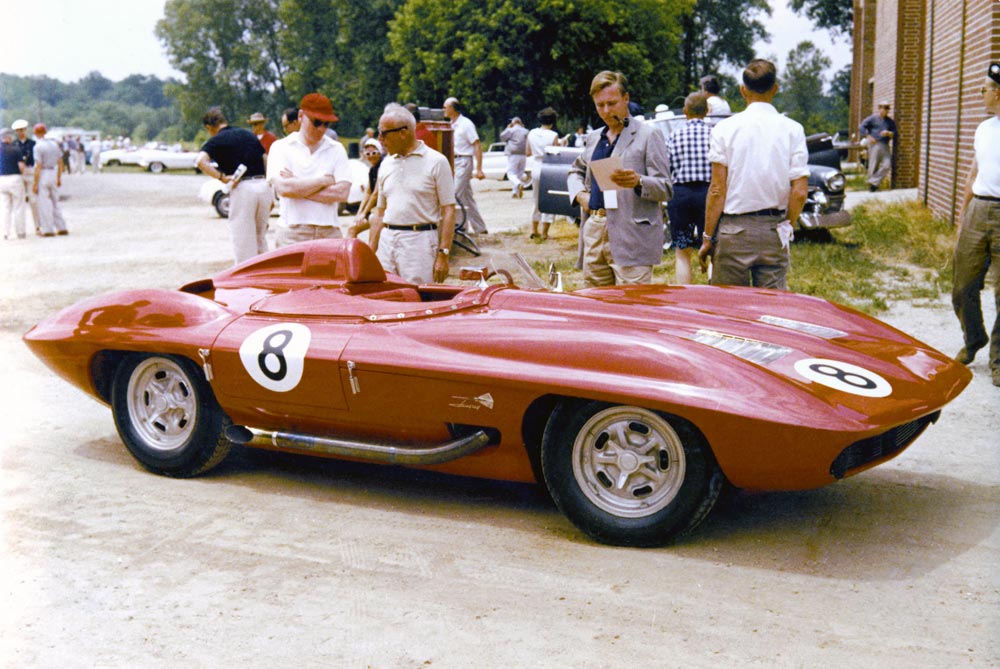
59_stingray-racer-msthd.jpg


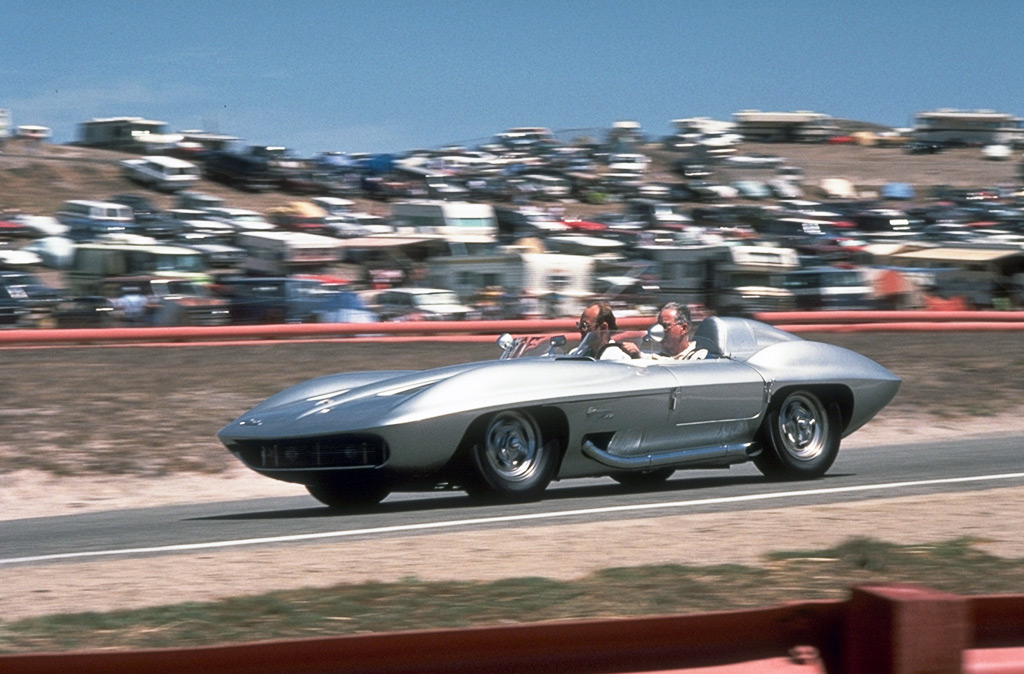
1959 Sting Ray Racer at Elkhart Lake racetrack, June 1959. Photo: GM Archives
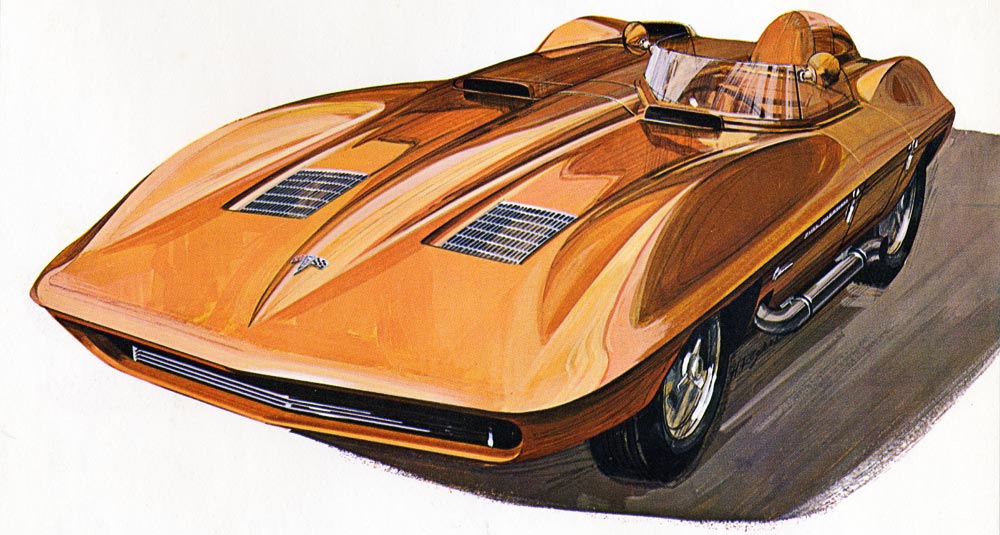
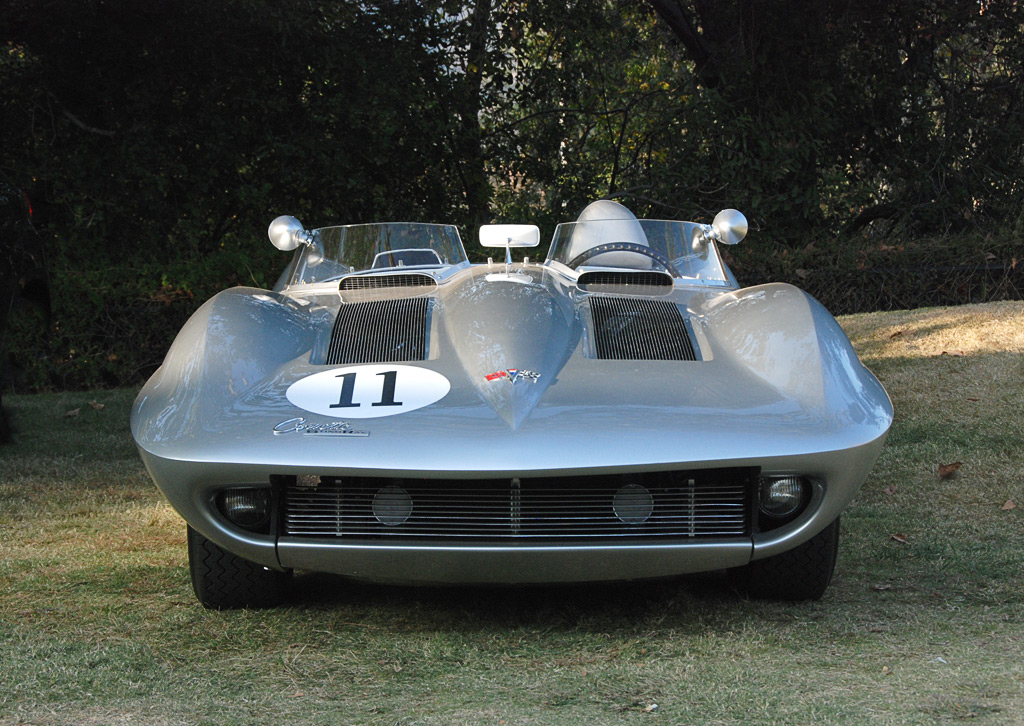
The 1959 Sting Ray Racer was Bill Mitchell's (GM Vice President and head of Design Staff from 1958 to 1976) brainchild. During a 1957 visit to the Turin Auto Show, his keen eye was drawn to a low, aggressively streamlined form draped over a miniature racing car. It was a Fiat, heavily worked on by famed tuner Abarth and styled by coachbuilder Pininfarina. It had a very low wind cheating shape known as the "streamliner" theme with four distinctive blips above each wheel which allowed the rest of the body surface to be very low.

That mercurial moment - centered on the blips above the wheels - would lead to the creation of the Sting Ray Racer and forever change Corvette history.

Above: 1952 Alfa Romeo Disco Volante, which Bill Mitchell also admired. Notice the belt line around the entire car separating the lower and upper halfs which would become an important styling element of the 1959 Sting Ray Racer and the C2 Corvette.

In 1957 the AMA (Automobile Manufacturer's Association) instituted a ban on everything related to "performance" which included all competition activities and extended to advertising in which all references to power or speed were forbidden. While under the guise of "public safety" the real issue was economics as the bean counters felt spiraling competition costs were too much of a drag on the bottom line. The new rule was strictly enforced, with punishment possibilities including losing your job. Still there were many brave and dedicated people who devised end runs around the ban, including Bill Mitchell and members of his staff.

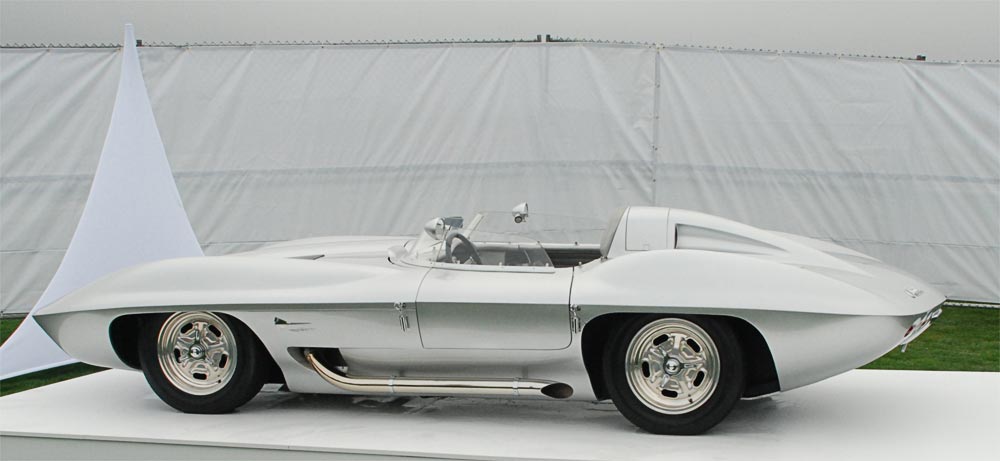
To get around an industry wide racing ban, Bill Mitchell (above, with the Sting Ray Racer and his 1961 Corvette Mako Shark) purchased a mule (industry term for a prototype used for testing and development) chassis and proceeded with a private racing endeavor. A small crew of designers that was part of Research Studio B which was under the radar of the higher level GM executives was responsible for transforming Mitchell's ideas into reality. Since the car was owned by Bill, it carried no GM, Chevrolet or Corvette labels until it was purchased by GM.


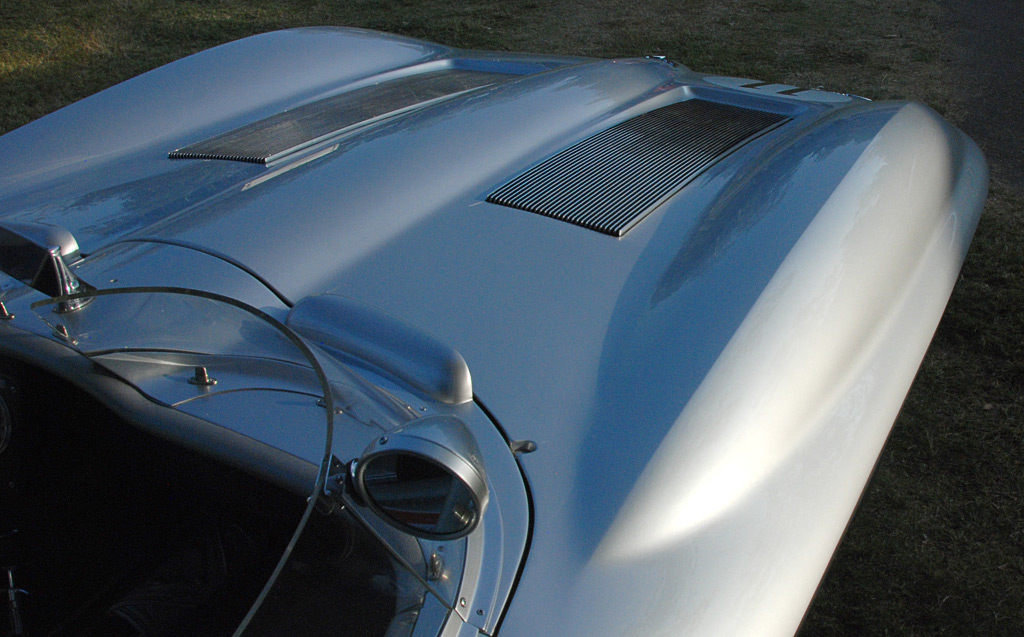
The wheelbase for the Sting Ray Racer was 92 inches, 10 inches shorter than the standard 1959 Corvette. Overall body length was 175 inches, only a bit shorter than the 177.5 inch '59 Corvette. Weight was around 2,100 lbs., about 1,000 lbs. less than the 1959 Corvette. The frame was not related to the stock Corvette and consisted of steel tubing. The front suspension was a short / long arm and the rear was a deDion design, which can be thought of as halfway between a straight axle (as seen on 1953 to '62 Corvettes) and an independent arrangement, as on 1963 and later 'vettes. The differential was a quick change Halibrand unit. Originally the braking was via finned drums which proved themselves a serious competition disadvantage. Four wheel disk brakes were eventually fitted. The suspension featured coil springs on all four corners.

The body skin was made of comparatively thin fiberglass backed up with aluminum reinforcement which was eventually replaced with balsa wood. The engine compartment featured a mechanical fuel injected small block with aluminum radiator and high compression cylinder heads.

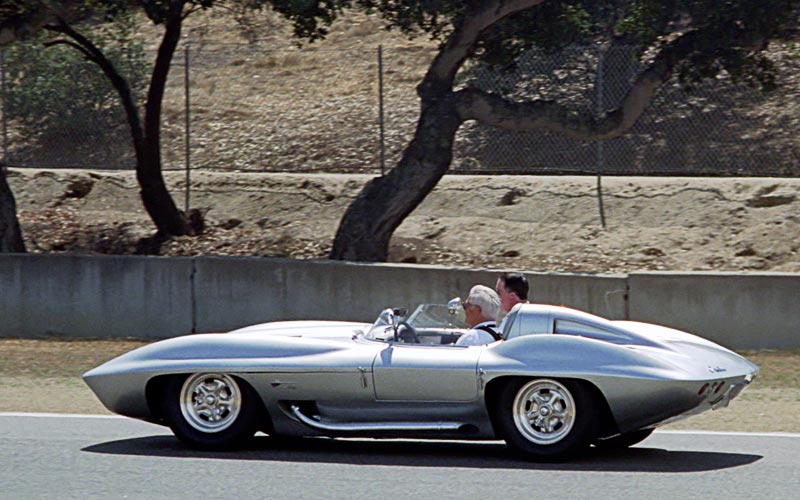
As originally built by Bill Mitchell, the 1959 Sting Ray Racer did not carry any GM, Chevrolet or Corvette identification. After it was purchased by GM, it was painted silver and featured at the 1961 Chicago Auto Show. A passenger windshield was also added. The insignia, the same as used on 1963 Corvettes, was added in 1961.

The evolution of the 1959 Sting Ray Racer to the 1963 Chevrolet Corvette Sting Ray (below) is evident.
 
Stingray Racer part deux

1959 Sting Ray Racer


The Sting Ray Racer did more than just look great; it also had a very successful racing career. It finished fourth in its first race. Driven mostly by Dr. Dick Thompson ("The Flying Dentist", right) it dominated the Sports Car Club of America C-Modified class in 1960. The Sting Ray Racer had the championship wrapped up only half way through the season. In ten races, Dr. Thompson had more than twice the points of the nearest competitor.
Following it's show circuit career, Bill Mitchell then used it as his personal car, which was his typical way of doing business. It also had a cameo roll in the Elvis Presley movie, "Viva Las Vegas".


Details are special throughout the Sting Ray Racer. Below right, wheels are cast magnesium.


Above: Early publicity for the 1959 Sting Ray Racer, which was sometimes known as XP-87.

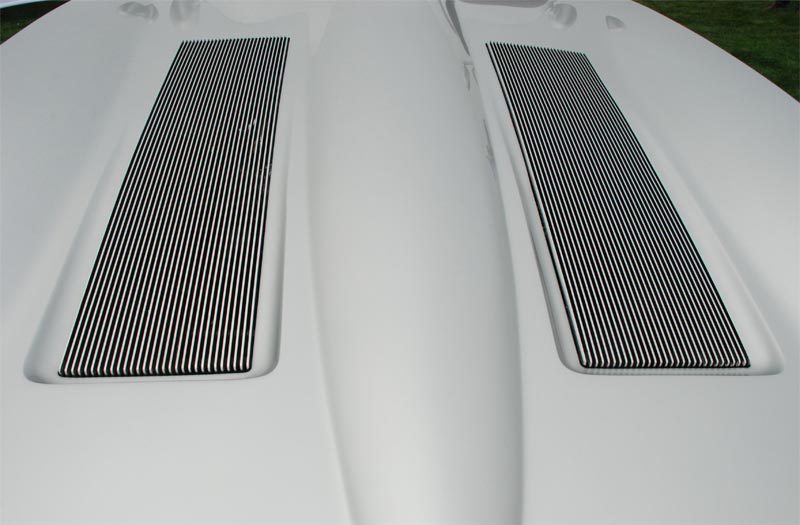
Hood vents also appeared on the 1963 Corvette. While they were functional on the 1959 Sting Ray Racer, they were for style only on the stock 1963 Corvette (right).

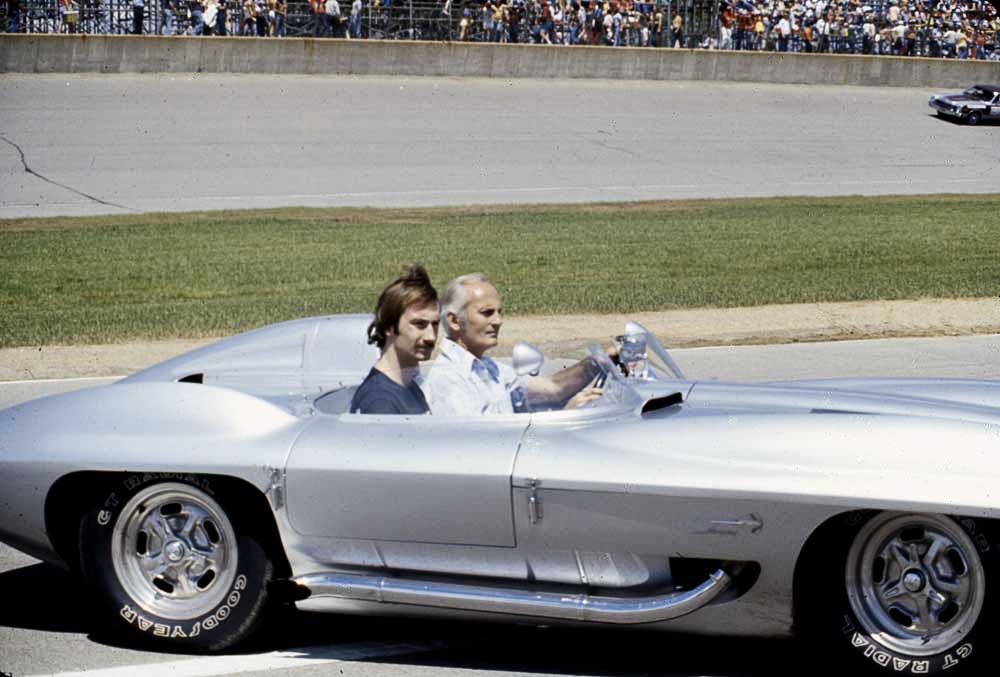
Famous GM designer Chuck Jordan and his son Mark Jordan test drive the 1959 Sting Ray Racer at Michigan International Speedway, mid 1970s.


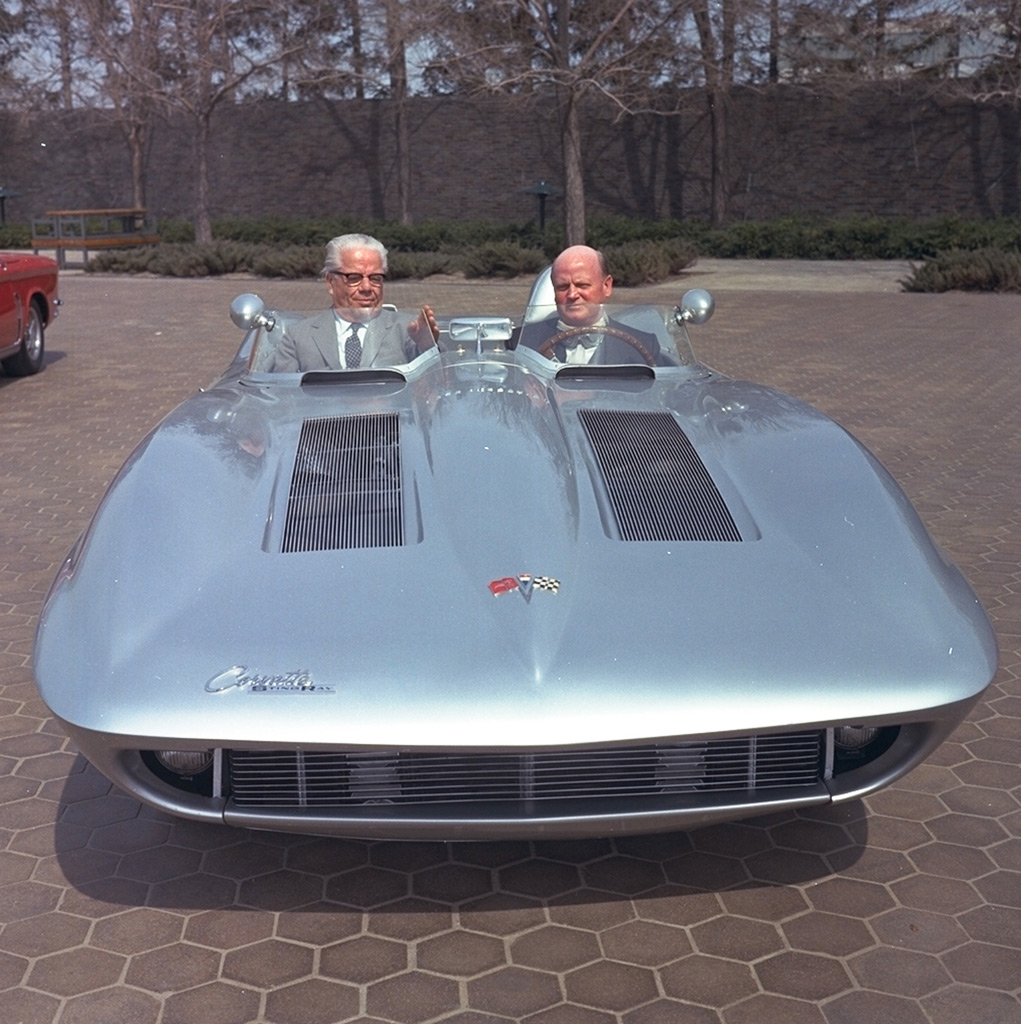
Bill Mitchell discusses his 1959 Sting Ray Racer with Italian designer Battista Pinin Farina, founder of the Pininfarina coachbuilding company.


The Sting Ray Racer evolved constantly during its early career, first painted red and then silver. Engines and chassis items (such as brakes) also changed. Note for example the more minimal hood louvers.


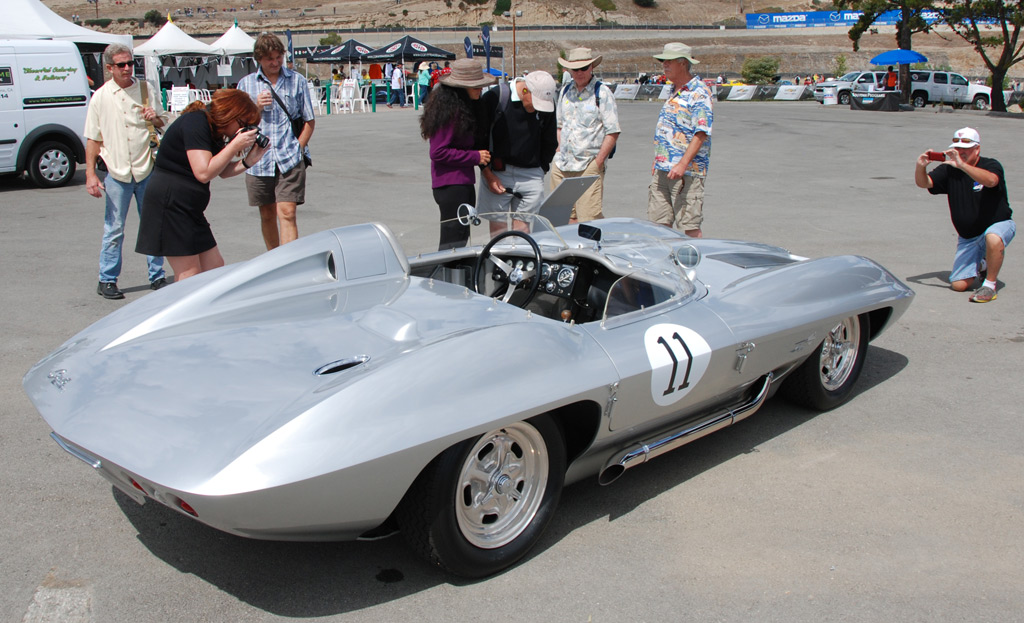
The 1959 Sting Ray Racer continues to attract fans as seen at the 2013 Rolex Monterey Motorsports Reunion. The car has been used extensively by GM as a promotional vehicle, a task for which it is eminently qualified.

 
First Sting Ray

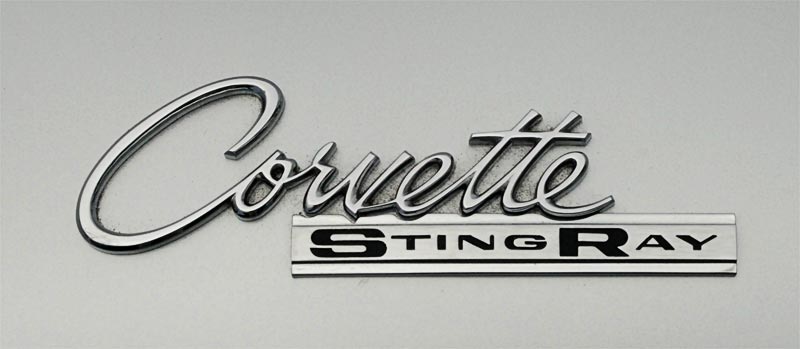
The C2 Corvette Sting Ray was first introduced in 1963.
The initial design was inspired by a car called the Q Corvette, a vehicle conceived by Chuck Pohlmann and Peter Brock but never manufactured.
The production 1963 Corvette Sting Ray was designed by Larry Shinoda with styling direction from Bill Mitchell.
 
Derek, do you supposed that Peter Brock is the same designer that developed the Cobra Daytona Coupe for Ford/Shelby? The Daytona was Fords go to endurance race car prior to the introduction of the Ford GT 40 series of cars.

This is a great thread. I have a ton of old magazines from the 60's but no scanner at the moment. Will have to get working on that.
 
Derek, do you supposed that Peter Brock is the same designer that developed the Cobra Daytona Coupe for Ford/Shelby? The Daytona was Fords go to endurance race car prior to the introduction of the Ford GT 40 series of cars.
This is a great thread. I have a ton of old magazines from the 60's but no scanner at the moment. Will have to get working on that.

You are correct Murray :thumbs: same guy

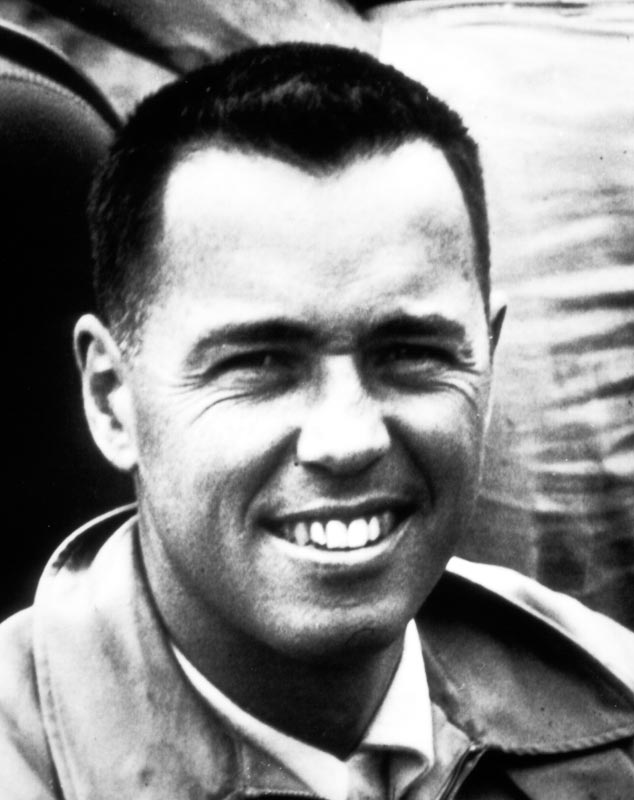
Peter Brock (born November 1936) is an automotive and trailer designer, author and photojournalist from the United States of America, who is best known for his work on the Shelby Daytona Cobra Coupe and Corvette Sting Ray.

Glad you are enjoying the tread.
 
Old Thread: Hello . There have been no replies in this thread for 365 days.
Content in this thread may no longer be relevant.
Perhaps it would be better to start a new thread instead.

Users who are viewing this thread

Back
Top